

Catch My Drift? Part 2
Wide Awake In Name Only

Part 2 of 2 on political linguistics
It’s a clear October night, the air hangs like a held breath. In the distance, a low orange glow stretches for several miles and melts into the horizon. It’s not a river of fire, but close. As it weaves toward Chicago, torch-lit shadows of thousands of young men— all radical Republicans— dance across apartment facades and shop windows. They hold high six-foot kerosene torches and the conviction of 70,000 brothers simultaneously marching across New England. Some clutch brass knuckles, ready if Democrat thugs attack. Along several paths, they do. A few broken bones and blood-stained sidewalks foreshadow a magnitude of violence they can’t yet comprehend, at least not in the fall of 1860.

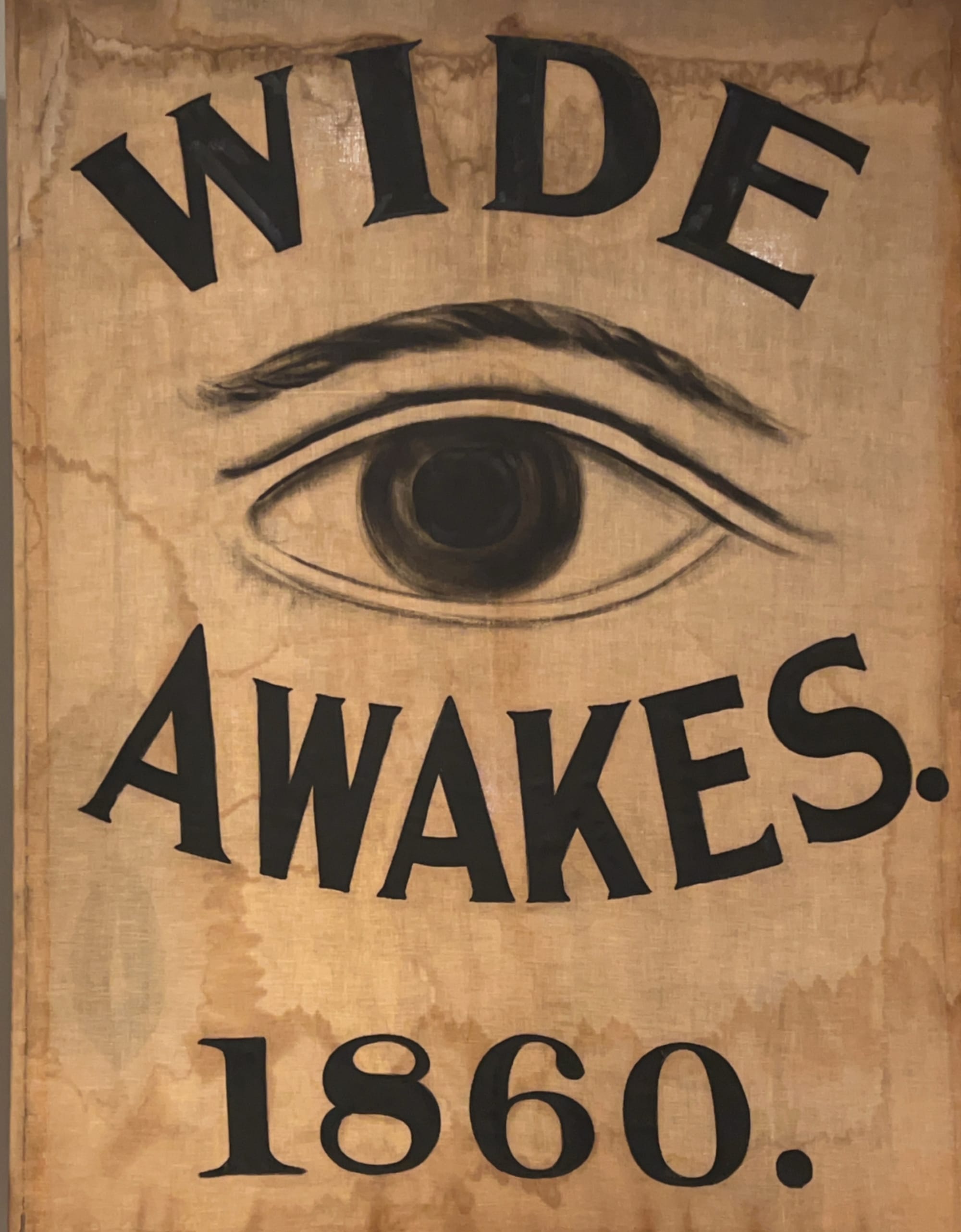
These Republican activists were headed to a campaign rally for a frontier lawyer the establishment saw as a backwoods agitator, Abraham Lincoln. Several months earlier in Hartford, Connecticut, they provided security and a torch-lit escort for Lincoln himself. They called themselves the “Wide Awakes.”
It’s unclear whether “Wide Awake” meant “woke.” Most likely, it came from their nocturnal marches. Some members were white laborers affiliated with the Free Soil, Free Labor platform. They were self-preservationists, afraid of losing their jobs and businesses to a Northern embrace of slavery. Other members viewed slavery as a moral imperative. Speakers at Wide Awake rallies, such as Cassius Clay and Boston Wide Awake Club Leader Lewis Hayden, an escaped slave himself, took up Lincoln’s mantle, using religious and moral terms to condemn slavery. Many Wide Awakes went on to be Union soldiers and leaders.
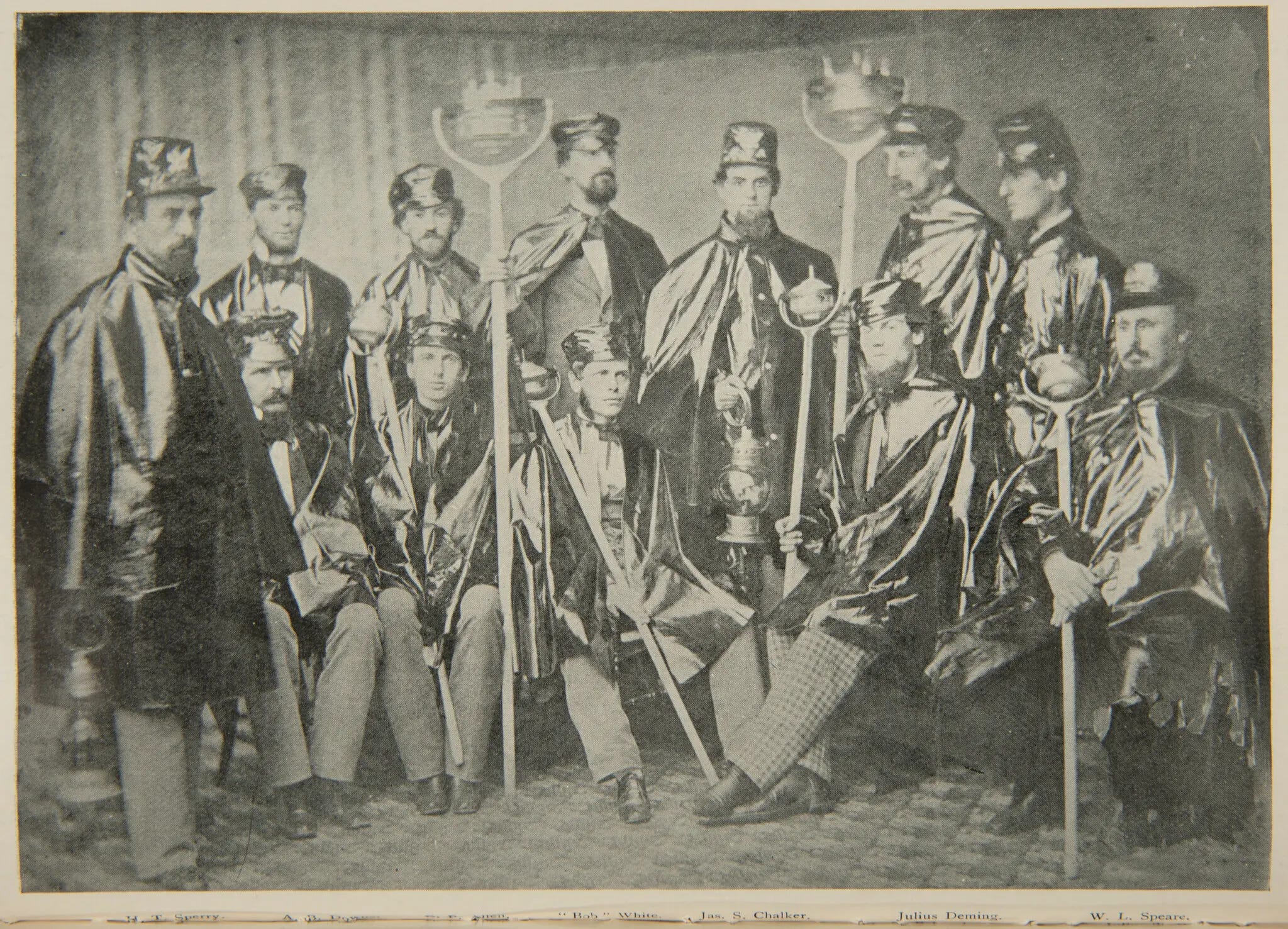
In hindsight, the image of the Wide Awakes with their lamps evokes the Unite the Right rallies in Charlottesville. Two groups with the same party affiliation and similar pageantry, yet opposing ideologies. Pro-Nazi white supremacists protesting the removal of a General Robert E. Lee statue would likely view the Wide Awakes as woke. The Wide Awakes would see them as the Confederacy. Both groups would consider the other RINOs (Republicans In Name Only).
In America’s two-party system, the theater is permanent, and the names on the weathered marquee remain the same. But between acts, the players are known to swap costumes one piece at a time. If a third party auditions, it’s quickly stripped and relegated to the lighting crew.
Following the Civil War, the realignment of Democrats and Republicans was a century of calculated repositioning, punctuated by violence. With a stronghold on power, the Party of Lincoln pivoted from the rights of Black Americans to big business. The Great Depression sank their favorability. FDR and the New Deal expanded government and social services. The Republicans argued for small government, then states’ rights — each a genuine identity in its moment, each now more costume than conviction. By the late 1950s, the rise of the Civil Rights movement created a regional fault line that cut across party lines. In 1964, Barry Goldwater’s opposition to the Civil Rights Act drew the first Southern Democrats toward the Republican column. Someone took notes.
Nixon’s strategist, Kevin Phillips, published the playbook. His 1969 book The Emerging Republican Majority argued openly that a permanent Republican majority could be built on white racial resentment in the South and ethnic backlash in the North. Nixon had already run the first play in his 1968 campaign with “law and order” and the “silent majority.” The aim was to win white southern voters with coded language that stirred racial resentments. When Lyndon Johnson signed the Civil Rights Act, he told an aide, “I think we just delivered the South to the Republican Party for a long time to come.” He was right.
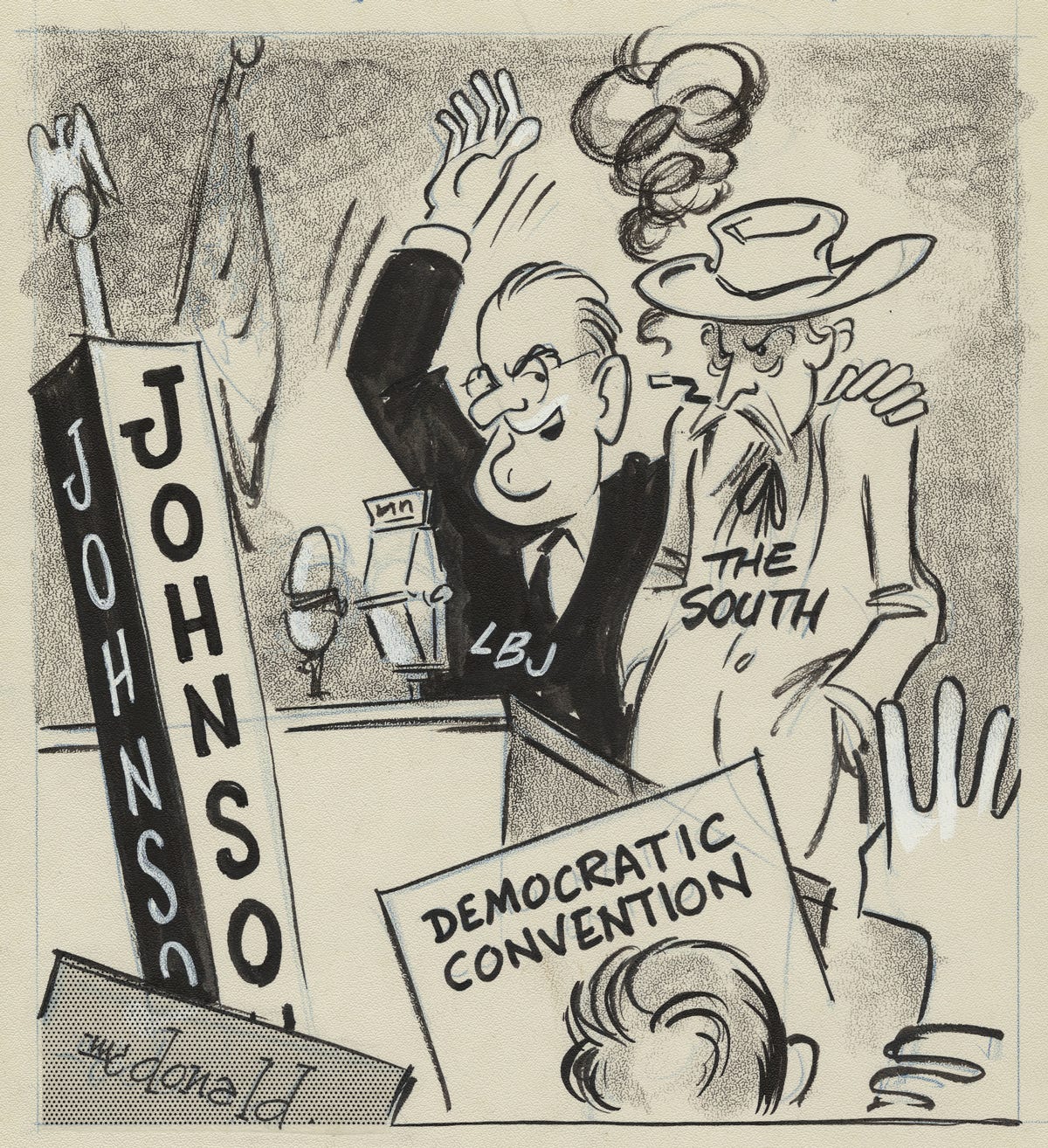
The Civil Rights Act didn’t end the racial politics of the South — it drove them underground. Explicit segregationist language was a liability in national elections. A new vocabulary was needed. The Southern Strategy provided skillfully calibrated dog whistles to reach the ears of the Southern reactionary without shattering the delicate glassware of the Northern moderate. This wasn’t an organic movement; it was rebranding. Districts began flipping. Reagan’s election marked its consolidation at the presidential level — Newt Gingrich’s 1994 Contract with America and the Republican Revolution completed its sweep through Congress and state legislatures alike.
In a 1981 interview after Reagan’s victory, Lee Atwater, one of the strategy’s most candid conductors, cold-bloodedly admitted that the goal was to shift from explicit to abstract messaging:
“You start out in 1954 by saying, ‘Nigger, nigger, nigger.’ By 1968, you can’t say it anymore. So you say ‘forced busing,’ ‘states’ rights.’ You’re talking about ‘cutting taxes’ — totally economic things — and a byproduct is blacks get hurt worse than whites. Race is coming on the backbone of all this.”
“Democrat” and “Republican” are more than labels; they’re identities. Yet, a keen strategist can exchange their geography, constituencies, even souls, all while people who identify as one or the other keep the nomenclature. According to the American National Election Studies (ANES), political party affiliation is one of the most stable political attitudes throughout an American’s life. Over 81% of Republicans and 89% of Democrats share their parents’ party affiliation and religion. Every five years, roughly 13% of American voters change their party. Most who do are under 30. Over the past decade, the trend among voters hasn’t been to switch parties but to vote as independents. Currently, 46% of the electorate identify as “independents.” Most still lean toward a preferred party and vote accordingly. Only about 10% are genuinely independent voters.
It’s commonplace for Republicans today to refer to themselves as the “GOP” or “Party of Lincoln.” Prominent Democrats would argue that the Democrats are the party of Lincoln’s ideals. This raises a deeper question: where do political terms like Democrat, Republican, Socialist, or Communist derive their popular meaning? How is that meaning vulnerable to deliberate attenuation?
Where slang trickles up from subcultures and marginalized communities, prescriptive or specialized language trickles down from scholars and experts. Ideally, it does for specialists what good terminology should: distill complex ideas and abstract concepts within a given field into precise, efficient shorthand. It helps psychologists diagnose. It saves surgeons time, allowing them to save lives.
Specialists seek to mitigate confusion and error through explicit criteria. Consider schizophrenia. Psychologists diagnosing mental disorders are required to consult the DSM-5 (Diagnostic and Statistical Manual). For each disorder, the DSM-5 provides a spreadsheet with two or more columns, each containing a list of possible symptoms. To be diagnosed with a psychological disorder, a person must have a particular number of symptoms from each column — but not necessarily all.
Column A: a patient with schizophrenia must exhibit two or more of the following: delusions, hallucinations, disorganized speech, catatonic behavior, diminished emotional expression.
Column B: they must exhibit one or more of… and so on. While two people may not experience all of the same symptoms, a professional can still conclude that both people are schizophrenic.
Political terminology is specialized. It’s derived from centuries of philosophy, history, and scholarship. Like psychology, it relies heavily on quantitative methods, such as data collection and statistical analysis, to categorize and condense abstract ideas. Political scholars debate and undergo peer review to test definitions and develop working agreements. These methods help political scientists better understand and describe politics. In practice, clearer language should improve how politics serves the people. But what sets political terminology apart from pure scientific fields—especially in a democracy—is that it operates in two worlds: general language and specialized language. This is where the need for an informed citizenry becomes crucial, and a politician who uses language as a weapon can create confusion.
In medicine, a specialist makes the call. In a democracy, everyone does. Where political scientists use political terms to diagnose, politicians use them to persuade. This can clarify issues for voters. It can also open the door to a linguistic chop shop where stolen words enter only to come out with new paint jobs and louder engines. Autocrats will drive them around, blowing through stop signs like a boozed-up Tiger Woods, trying to convince everyone they’re the “specialist” while slamming into anyone who is. It doesn’t take long for political discourse to become a demolition derby.
The wreckage is familiar. Confucius warned that when language loses its accuracy, justice goes with it. Plato made it structural — in the Republic, Socrates argues that free speech is simultaneously democracy’s greatest strength and its fatal weakness, the open door through which demagogues enter and then dismantle the very freedoms they build their platforms on.
George Orwell addressed political words failing to hold meaning in his 1946 essay Politics and the English Language:
“The word fascism has now no meaning except insofar as it signifies ‘something not desirable.’ The words democracy, socialism, freedom, patriotism, and justice each have several different meanings that cannot be reconciled with one another. In the case of a word like Democracy, not only is there no agreed-upon definition, but the attempt to make one is resisted from all sides. It is almost universally felt that when we call a country “democratic,” we are praising it…”
Political terms, when we need them most, are often diluted by overuse and hyperbole, or reduced to pejoratives. Trump has a way of stringing them together in nonsensical insults. Like when he called Kamala Harris a “communist, Marxist, socialist, fascist.”
Part of Trump’s America First agenda has been to stake a percentage claim in national companies such as Intel, raise taxes through tariffs, and send a masked and militarized police force into the streets to arrest without due process. His diagnosis of Harris is a projection on a level that would make Freud blush. Yet all his base heard was Harris being called four bad words in a row. That gets reduced a step further to just “bad.” The words themselves begin to lose meaning in the greater public.
Following in the wake of the Southern Strategy, the Trump administration is further redefining “Republican.” When he calls Republican Supreme Court justices, senators, generals, and governors, RINOs, he’s saying what “Republican” means — loyalty to him.
The Southern Strategy didn’t just transform the Republican Party — it fundamentally altered what it meant to be a Democrat. The Dixiecrats, who remained after Johnson signed the Civil Rights Act, became Democrats In Name Only — DINOs — to the urban, multiracial coalition that would define the party going forward. George Wallace was a Democrat. So was the Solid South that built its identity on segregation. Today’s Democratic Party would be unrecognizable to them, and vice versa. Trump understands this instinctively, which is why “Democrat” functions in his vocabulary the same way “RINO” does — not as a description but as a weapon. Both words have been emptied of meaning and reloaded with contempt. In Trump’s lexicon, a “RINO” is anyone who won’t bend the knee, and a “Democrat” is anyone loyal to the ideologies and principles he’s threatened by. The actual content of either party’s platform is beside the point. The words are just ammunition.
The assault runs in both directions at once: from the bottom up, where slang and vernacular get mocked into pejoratives, and from the top down. The more words an autocrat can warp, weaponize, dilute, or ban, the more control they can have over citizens. Political terms are vulnerable because of their general use. That doesn’t mean other specialized language is safe. It has an address. It lives in universities, journals, and peer-reviewed publications — institutions with budgets, accreditation, and the persistent vulnerability of anything that depends on public funding and political goodwill. That’s what makes it precise. It’s also what makes it a target. Slang gets mocked into irrelevance — “woke” becomes a punchline. Academic language gets hit from both directions: mocked into pejoratives and starved at the institutional level. “Elite,” “academic,” “expert” — once markers of credibility, now campaign insults. Autocrats understand this. You cut social programs and elementary schools to defund the street corner where slang and poetry are born. You punish the universities to make education sound like something to be ashamed of. Trump has framed his attacks as a defense against “antisemitism.” But that’s just a further distortion of language.
I’ve heard it argued that Trump doesn’t understand many big words. Hearing him discover the word “groceries” doesn’t dissuade such assertions. That doesn’t mean he’s too dim to be dangerous. Titling his overtly dishonest social media posts “Truths” shows an intent to co-opt not just words but truth itself. As words lose their meaning, the loudest and most widely heard person effectively owns the definition.
In the fall of 1860, the Wide Awakes marched with torches and a shared vocabulary — liberty, union, republic — words they believed meant something specific enough to die for. Some of them did. But words can outlast convictions. One day, someone may pick up your torch and carry it in the opposite direction. When that happens, don’t forget who first lit it and why.