
UFC Enters The White House
What a cage match on the south lawn gets wrong about martial arts and men
Middle age finds you quickly. You accept it or get weird. One day, you’re a kid wearing R2D2 pajamas; the next, you’re chasing a delivery robot blocks past the sandwich shop you ordered from because it glitched and skipped your office. Time will tell if the Force is strong with you. Your knees will tell you the clock is running.
Whatever you do, don’t get bitter. There’s freedom in discerning limitations from obstacles. If you’re lucky, you spot a few when you’re young.
On a basketball court in seventh grade, when Chris Weaver, at six foot three, held his arms over my head like a skyscraper, I knew I wasn’t tall enough to make the team. I still enjoyed the game.
Shortly after, I enrolled in Paul Gale’s Chinese Martial Arts Academy. There, I learned to accept that there’s always someone bigger and better. It’s one of life’s few guarantees. So is knowing we’re all on level ground when we’re six feet under. The greatest competition is with who you were yesterday. The only way to surpass that guy is to admit your mistakes. That’s how training becomes an expression of humanity.
It doesn’t happen in isolation. No one reaches their potential alone. We are born dependent and wired for connection. Mastery isn’t a trophy or credential; it’s when you’ve learned just enough to be in the service of others. Then you keep studying.
It was in that kwoon that I discovered what kind of man I wanted to be. Decades later, looking toward the nation's capital, I’m seeing a government attempting to replace those values with a cheap, disposable imitation of manhood — a consumer product manufactured entirely for the whims and entertainment of the ruling class.
June 14th marks the president’s eightieth birthday, a milestone celebrated not with a reflection on a life well lived, but with a violent spectacle of dominance. The guest list is a curated selection of elite loyalists, celebrities, and a few thousand active-duty troops screened to meet strict on-camera body-ratio requirements.
On the South Lawn of the White House, workers have erected a temporary, foundationless fighting cage. The president has openly expressed a desire to make it permanent, comparing it to the Eiffel Tower. It’s a particular distortion. One is a monument to human ingenuity, an elegant spire woven into the fabric of the city of love. The other is an enclosure where human body bags are bought and paid for to flatter the vanity of a national brand in decline. To mistake the power to confine for the power to inspire reveals the limits of the autocratic mind.
It also reveals the target demographic. This exhibition is for a generation of young men filled with uncertainty and beginning to drift—boys who have spent their formative years watching the ladder of upward mobility pulled up by grifters and heirs to generational wealth. The political faction that once promised to lower that ladder is losing them. The same leaders who have left them stranded are telling them you’re either a winner or a loser. The weak deserve no mercy.
That transactional worldview extends directly to the logistics of the spectacle itself. A failed legal challenge targeting the upcoming weigh-in at the Lincoln Memorial alleges plans for each fighter to enter the press pool hand in hand with a child. If true, it would add to the cynical staging mechanism by turning youth into a prop for the kind of men the administration wants them to be.
My very first memory is of being carried by an athlete. I was three. My mother and I were on a plane somewhere between Los Angeles and New York. There was a man playing peek-a-boo with me over his seat. I don’t remember running back to meet him, though my mother said I sat with him until we touched down at JFK. In 1984, a well-behaved, curious kid was inflight entertainment.
My single mother was five feet tall in her good shoes. She’d grown up in a small town not far from where they filmed the Ewoks in Return of the Jedi, and had never ventured far beyond the redwoods. Nervous to navigate the terminal alone, my new friend told her, “Don’t you worry, little lady. I’ll get you to where you’re goin’.”
As far as I can tell, my life began riding through the airport on his shoulders. He was surely the tallest man in the building; to me, the tallest man in the world. He told us he played in the NBA—an LA Laker, but a New York resident. From that height, I flew above the crowd, watching the tops of people’s heads swirl like a human current as they hurried toward connecting flights and overpriced airport eateries. His hands wrapped around my calves, locking me in place. I felt safe. My mother held onto his belt—nearly parallel to her own shoulder—as we navigated the chaos. He got us our luggage, hailed a cab, and gave the driver explicit instructions. His name was Kareem Abdul-Jabbar.
I didn’t connect the man from the terminal to his legendary skyhook until decades later, relaying my first memories to my mother. She was stunned that I remembered that. I was so young. That’s when she told me his name. I thought immediately of Kareem’s friendship with Bruce Lee.
Kareem met Lee in 1967. Looking to study Tai Chi, he was pointed toward a young martial artist who’d played Kato on The Green Hornet. He was skeptical; he didn’t want to learn to act like a martial artist; he wanted to be one. At Lee’s Culver City home, Lee led him to the backyard and had him strike a heavy bag, then called out his wife, Linda, and told Kareem to hold the bag for her instead. Linda kicked it, sending the seven-foot-two athlete flying backward into the grass. Kareem knew he’d found the right place. He would eventually play Hakim—the Mantis—the guardian Lee fights at the top of the pagoda in his unfinished film Game of Death.
No matter what one makes of Bruce Lee, it’s impossible to deny his impact or separate the man from the performance. He was a complex, fragmented character: he preached the illusion of stardom while chasing Hollywood fame; he honed his body into a symbol of discipline while growing more dependent on illicit drugs to contend with chronic back pain from a weight-lifting accident; he rejected traditional frameworks while becoming the world’s foremost ambassador of traditional Chinese martial arts.
In his 1960’s kung fu demonstrations, the famous “one-inch punch” was undeniably fast, forceful, yet mostly theatrical. He’d set a chair behind the volunteer to “prevent injury,” hold his fist an inch from the man’s sternum, and strike; the volunteer always toppled into the seat—the post-demo chatter rarely noted that the chair was there and the volunteer, standing at attention with his legs parallel, would habitually fall back into it. Yet on film, Lee brought a centuries-old ethical code of Xiá to the screen by modernizing the classical Chinese knight-errant.
Long before it became a staple of Hong Kong cinema, the lore and ethics of the Xiá were forged in the chaos of China’s Warring States period, around the 4th century BCE. When the Zhou dynasty’s central authority collapsed into lawlessness, individual martial artists rejected state allegiances and official armies—some on their own quests for justice, others in private networks. Driven by a philosophy of defensive altruism, the classical Xiá answered only to an internal compass of righteousness, operated on the social margins—a realm called the Jianghu—and used violence exclusively as a shield, to protect the vulnerable from predatory rulers and tyrants. Some saw them as heroes. Others saw dangerous vigilantes.
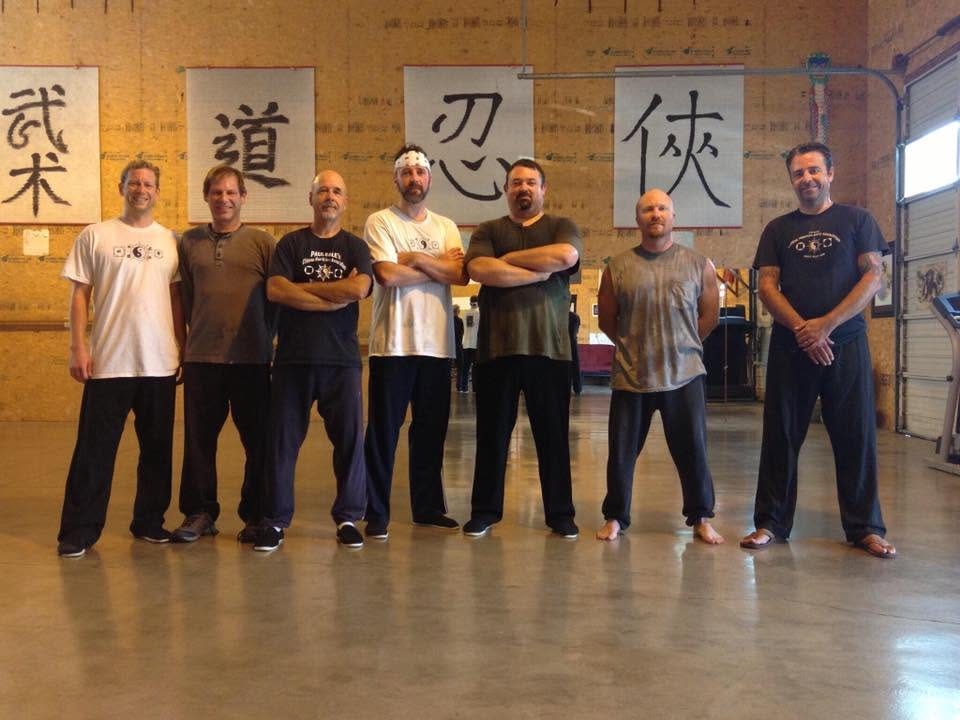
The first time I walked into Paul Gale’s warehouse, four calligraphy banners hung from the plywood wall: 武 (Wǔ), martial arts/ethics; 道 (Dao), the way/path; 忍 (Rěn), patience/forbearance; and 俠 (Xiá). But I didn’t know what they meant.

The Xiá was preserved and romanticized through wuxia literature—serialized martial-hero novels of righteousness, lineage, and honor. Wuxia reached Chinese cinema as early as the 1920s and found new popularity in the 1960s through the Shaw Brothers’ Hong Kong grindhouse films. Crouching Tiger, Hidden Dragon (2000) was the first and only wuxia film to be a box office hit in the U.S.
When Bruce Lee stepped in front of a camera in the early 1970s, he mapped the Xiá’s radical, anti-establishment core onto a gritty, modern reality. He wasn’t the first to do it. But he was one of the most beloved. Across his early films—The Big Boss, Fist of Fury, and The Way of the Dragon—the narrative remained constant: a rigorously trained, working-class underdog, fighting a corrupt system on behalf of an exploited community. His characters never fought for wealth, status, or to prove they were the alpha of an arena. The violence always began reluctantly—a defensive response to a breach of basic human dignity—and you could read the immense personal cost of that violence in the way Lee contorted his face at each killing. He was a protagonist constantly wrestling with the fear of becoming the very thing he was fighting against.
Lee’s American breakthrough, Enter the Dragon, debuted a week after his death and made him a legend overnight. A blend of sixties spy film, blaxploitation, and “chopsocky” action. Critics panned it; audiences loved it. It became one of the most profitable films ever made, and in 2004, the Library of Congress preserved it as “culturally, historically, and aesthetically significant.”
Lee plays a Shaolin instructor sent by British intelligence to enter a full-contact tournament on a private island to investigate the rogue Shaolin warrior who runs it. On the boat out, another fighter, summoned to compete, demands to know his style. “The art of fighting without fighting,” Lee says. The fighter challenges him to fight on the spot. Lee tricks him into hopping into a lifeboat, maroons him without a punch, and hands the tow rope to the deckhands he had been tormenting before approaching Lee.
The villain, Han, is the ultimate perversion of martial mastery: his fortress is a hub of drug trafficking and sex slavery, where young girls are locked up, drugged, and forced into prostitution, their discarded bodies washing ashore. Fighters are both entertainment and recruits; those Han deems worthy get one choice—pledge their fidelity to him and join the crime ring, or die. Lee tears the structure down from the inside out. In the climax, he’s caught in a literal hall of mirrors, until he realizes the only way to see the enemy clearly is to smash the glass.
Watching Enter the Dragon today, that fictional fortress doesn't feel entirely confined to the screen. UFC middleweight champion Sean Strickland inadvertently drew an eerie parallel when he bluntly turned down his invitation to the fight, “I think I’d wanna do the White House… but, like, just to go hang out with the fucking Epstein list?”
By the 1980s, the Reagan era had splintered and reshaped the moral core of the lone-hero archetype through nationalism, rugged individualism, and single-parent households. A Hollywood actor turned president and figurehead of the religious right, Reagan understood the power of the hero story, projecting himself as the hero of America’s economic standing and a moral superiority over communism.
It was the decade of the latchkey kid. As divorce rates climbed, so did a conservative anxiety that fatherless boys home alone after school would grow up feminized. When those boys looked to the glowing screen for a blueprint of manhood, the entertainment industry was ready to supply it.
I was one of those boys. I’d stand in front of the TV in my PJs imitating Bruce Lee. Thanks to an expansive local video store, I gravitated to Hong Kong houses like Shaw Brothers and Golden Harvest; I watched reruns of Kung Fu on Superstation TBS. I was embarrassingly too young to have a strong analysis how a white man had come to star in the series Bruce Lee was deemed too Asian to play.
The advent of VHS kept the classics and grindhouse films in circulation during an explosion of global action cinema, and one branch of the new films was aimed at boys like me. Instead of kung fu heroes defending the defenseless against organized elite power, they offered a domesticated surrogate patriarch and a path to personal fulfillment. The Karate Kid captured the transition, trading the political rebellion of Xiá for a suburban morality play in which a fatherless boy finds structure, discipline, and a sense of self through a wise old mentor who teaches that violence is a last resort. Class struggle wasn’t disavowed, exactly, but it wasn’t framed as a systemic issue. Instead, it was something that, no matter the odds, could be overcome through perseverance.
The Karate Kid also ushered in the era of the McDojo. Martial arts schools popped up beside grocery stores and laundromats in brightly lit strip malls across America. Boys flocked to them, most dropping by tryouts for the next sports season. To retain enrollment, some schools expanded the belt system with more colors and incremental stripes, betting that frequent rewards would create a sense of accomplishment. Children with black belts learned that imitation got you bragging rights. Though most wouldn’t know what to do if a 200-pound man punched them in the nose.
When I discovered there was a kung fu school in the neighboring town, I begged my mother to take me. I arrived a few minutes after class had begun. I pushed open the door, setting a wind chime ringing. To my left were chairs and an end table with jasmine tea brewing. I sat, taking in the blended scents of jasmine and the musty plywood walls rising a couple of stories. The sifu, Paul Gale, glanced my way without breaking his count—“Move... Move...”—on each call, the students moved with a step, followed by a punch. I watched for at least half an hour before he came over. He welcomed me but said he didn’t teach kids; he wasn’t a babysitter. I was welcome to watch. When class ended, I grabbed a flyer—gung fu (southern Chinese kung fu) at 6pm on Monday, Wednesday, and Friday.
So I attended the next class. This time I was early. Paul ran the class, and afterward reiterated what kind of school this was. No belts, no rankings. Students spend years repeating the same basic moves. I’d be bored. No secrets, just fundamentals. This isn’t dance or theater. If I wanted to train like the movies, there might be a better fit for a kid like me. I thanked him and rode my bike home. While the strip malls inflated belts to keep kids paying, Paul was telling an eager pre-teen there was nothing here but work.
I’m not sure where I got the idea—I’d like to believe it came from deep historical knowledge or sheer perseverance, though it was almost certainly from David Carradine’s Kung Fu—that I should treat his refusal to teach me the way a boy treats the sifu who makes him wait outside the Shaolin temple. So I went back. Paul looked at me, then at the floor. He straightened his glasses, shook his head with a chuckle, and waved me over. “What size shoe do you wear?”
He dug a pair of cotton tai chi shoes from a box and handed them over with a shirt and a baggy pair of kung fu pants. Everything was too big. I was thrilled. That’s when I discovered the concrete floor was waxed and slippery. To this day, the thought of that floor humbles me. The goal was balance, posture, and coordination. Things we all think we have, but too easily find we don’t when it matters.
As the first kid he’d let in, I felt an obligation to represent. I trained several days a week—back-to-back gung fu and tai chi on Saturdays. When I couldn’t afford the classes, Paul let me work them off doing chores. In complete cliché, I’d find myself on my hands and knees, waxing that floor. He hadn’t grown up on martial arts movies, but he knew I had, and he understood that teaching is really a matter of linguistics—finding the language that clicks for a particular student. He was never shy about ridiculing the “mumbo jumbo” of the modern scene, but he couldn’t change the culture my generation was raised on, so he used it. It was, at minimum, a way to make the floor shine.
I swept, dusted, and cleaned the bathroom. For a few months, a friend from school trained alongside me, and Paul, wanting to cut the echo in the kwoon, had us paint the school’s emblem—a circle inside a square and a square inside a circle—onto large sheets of absorbent carpet. Despite the design’s simplicity, it took forever: layer upon layer, and several trips to the store for more paint. Tai chi, Paul’s sifu liked to say, is iron wrapped in silk; gung fu is silk wrapped in iron. Most people do circle-in-a-circle tai chi— no structure under the grace—and square-in-a-square gung fu, no grace, just rigidity. Paul had me painting philosophy.
Paul always reminded us that gung fu means hard work. Be a skillful, hardworking person, not a hardworking idiot. That involves more than one person, for or against another. To harm someone in hand-to-hand combat is to be as close to them as you’d be to an intimate partner. The longer you train, he believed, the more you understand how easy it is to hurt somebody, and therefore how precious people are. The ones numb to that are the ones willing to fight about and for nothing.
Learning to fight wasn’t about fighting. If you’re ever in a life-and-death altercation, you hope your body responds instinctively; It’s not about fancy moves, or 1,2,3 combos you learned from a form. In a fight, you keep your balance, grab the nearest object, and smash the hell out of your attacker or run away without tripping over your feet. But if you’re smart, you learn which alleys and conflicts to avoid in the first place.
He’d tell us that coming out victorious in a fight is something you treat the way you treat a defeat—like a funeral, because it’s ugly. The spectacle on the South Lawn is the inverse. The men who built the cage think they’re decorating a birthday party; really, it’s a stage where manhood is being choked out. Paul saw this decades earlier. Whenever the UFC came up, he called it a perversion of the arts—and asked, reasonably, how a thing can call itself no-holds-barred while barring biting, gouging, groin strikes, and blows to the throat. His own sifu, James Wing Woo, held the same opinion.
Woo was a fierce, seminal pioneer of Chinese martial arts in California, with mastery across Northern and Southern kung fu, Tai Chi Chuan, Qigong, and traditional Chinese medicine. He held an uncompromising view of what that knowledge demanded: without a strong foundation in traditional kung fu, everything built on top was performance. Flashy technique without structure wasn’t martial arts—it was choreography.
As the art spread across the world, that foundation was exactly what was being lost. Woo was antithetical to the drift, and so was Gale. “What I see these days,” Woo once said of the commercial scene, “is all these guys coming out and specializing in theatrics. They say they teach fighting, and make it look good for entertainment value, but unfortunately, that’s not training.”
Born in California in 1922, Woo spent his formative years in Canton, absorbing styles from the martial artists who’d flooded south as the Japanese advanced, before returning to San Francisco at sixteen to train among the Chinatown traditionalists. Like Bruce Lee, Woo drew on lessons from multiple styles, eventually founding his own system, Wing Woo Gar, and teaching anyone willing to learn.
One of his earliest and most commercial contributions has been routinely overlooked. In the early 1960s, Ed Parker—the “Father of American Kenpo”—brought Woo into his Pasadena studio to expand his system beyond its linear karate roots with the internal concepts of Chinese kung fu. Woo became the technical architect behind Parker’s seminal 1963 book, Secrets of Chinese Karate, breaking down the forms and demonstrating the movements; the illustrations are said to be based on him. In print, his contributions went entirely uncredited. Disillusioned by the dispute and by the commercialized direction of the art, Woo walked away. Parker soon found Bruce Lee and invited him to demo at his 1964 Long Beach Karate Championships, launching Lee into the California limelight.
It didn’t stop Woo. He opened his own academy on Hollywood Boulevard—no padded mats, no belts, no hollow praise—and in the 1970s Hollywood found him anyway. Sam Peckinpah was nearly thrown out of the studio before his entourage identified him. Woo went on to appear in fifteen films, from Killer Elite to Lethal Weapon 4, playing priests, clan elders, even a dead man, but never performing martial arts on screen. He taught for 53 years, until his death in 2014 at 92.
Gale began training with Woo while trying to make it in Hollywood himself. He landed guest roles in Sigmund and the Sea Monsters, The Bay City Rollers Show, and an episode of Magnum, P.I. His most prominent role was in the 1978 Star Wars Holiday Special—widely panned as one of the worst television productions ever made, so catastrophically received that George Lucas reportedly said he’d like to destroy every copy with a hammer.
Gale played Itchy, Chewbacca’s father, his face obscured inside a Wookiee suit. He’d been in the universe without making the team, and it had taken nothing from him. Hollywood held its hands over Gale like a skyscraper, and he found his way to manhood through martial arts anyway—the quiet inverse of the men the era was busy putting on posters.
The most popular 1980s action movies featured a hypermasculinity, with a new breed of Hollywood action stars such as Norris, Stallone, Schwarzenegger, Willis, and Gibson. They drew more from John Wayne, replacing the cowboy hat with massive sculpted muscles. The Jianghu was westernized into a cynical, dog-eat-dog conflict in which the hero fought not necessarily to liberate the weak but to avenge a personal slight, take down their enemies with brute physical strength, or simply to keep alive.
Unlike the underclass heroes of Xiá, these heroes were often militarized cops or soldiers. Their righteousness wasn’t against a corrupt system, but a means of shucking the law they were meant to enforce when it was an inconvenience to swift results. They were nationalistic but ungovernable, unrestrained judges, juries, and executioners. If they were in service to anything, it was to the rugged individualism of the era. Only the strong survive.
The 1988 film Bloodsport—a low-budget bridge between the suburban morality play and the hypermasculine action picture—launched Jean-Claude Van Damme on its slugfest, not its acting. It opens with boys breaking into a house to steal a samurai sword; all scatter when caught except Frank Dux, whom Sensei Senzo Tanaka tells that such a sword can’t be stolen, only earned, by winning a full-contact tournament called the Kumite. Tanaka takes the boy in. A grown Dux tells Tanaka he’s like a father to him, and goes AWOL from the Army to fight the Kumite in his honor.
The champion, Chong Li—played by Bolo Yeung, whose debut was in Enter the Dragon—blinds Dux in the final by crushing a hidden pill into his eyes. Dux, trained to fight blind, wins anyway. Training beats cheating. Dux returns to the Army a champion, with no penalty for desertion.
In a 1997 New Yorker profile of Donald Trump, Mark Singer hitches a ride to Mar-a-Lago with the future president. Among the passengers he names is Ghislaine Maxwell, along with Trump’s thirteen-year-old son, Eric. Trump pulls out an old favorite on VHS—Bloodsport, “an incredible, fantastic movie.” But the exposition bores him: the training, the surrogate fatherhood, the failure of theft and cheating. Instead of suffering through it, he has his kid, Eric, fast-forward straight to the fights.
Bloodsport was sold as the true story of Frank Dux, who’d choreographed its fights. The film ends with a title card displaying his record: undefeated in 329 fights, 56 straight knockouts in one tournament. A few years prior to Bloodsport, Dux had shared his story with Black Belt magazine, including photos of the tournament, his medals, his trophies, proof he was a champion of ninjutsu.
Within months of the film’s release, the Los Angeles Times separated the man from the myth. Dux had earned no medals. A local trophy shop produced the paper trail showing he had ordered the Kumite prizes himself, and the organization’s "international headquarters" was revealed to be his own home address. No Senzo Tanaka existed anywhere—except as an echo of “Tiger” Tanaka, the spymaster in Ian Fleming’s You Only Live Twice.
Yet none of it stopped Dux from claiming, in his 1996 book, to have been a covert CIA operator. While he sounds like someone Trump would give a cabinet position, Soldier of Fortune took him to task for stolen valor. The fictional kumite at the center of it all has been cited, more than once, as inspiration for the UFC.
One Saturday morning when I was about sixteen, I rode my bike to the kwoon. Halfway through, it began to pour. I was no stranger to riding in the rain, but as the others trickled out, I lingered, hoping for a break. Paul told me not to worry; he’d throw my bike in his van and drop me off. But first, he needed my help. He had some rice-paper etchings from the Shaolin temple he wanted on the walls, along with a couple of new banners.
The kwoon was a large warehouse, with a staircase climbing the north wall to Paul’s loft office. He wanted the banners hung, level with those on the south wall, but the ladder wouldn’t fit on the stairs. Even at six foot three, he couldn't reach the spot. He knelt and told me to stand on his shoulders. I hesitated, but he told me I had “legs”—shorthand for a decent horse stance and real structure. It was the highest compliment he could give. I trusted him.

I stepped my left foot onto his bent knee, swung my right leg over his head, and set my foot on his shoulder. He pressed my feet down onto his shoulders for leverage, stood, and walked to the table for the hammer and nails. He handed them up, climbed the stairs, and told me to set the nails as high as I could. I did. Then he walked back down with me still standing upright on his shoulders, took up the scrolls, handed them to me, and had me hang them. Back on the ground, we sipped some tea and marveled at the new art on the wall.
Paul went up to his office to finish his paperwork while I ran the push broom across the floor. When I finished, I walked up the stairs and stood by his bookshelf, reading the spines. He had a row of religious texts stacked together. Half joking, I asked him which one was right.
He looked up from his desk. He told me I should read them all. Then he said, “Look, there are good Christians and bad Christians, good Buddhists and bad Buddhists, good Hindus and bad ones, good Muslims and bad Muslims. It doesn’t matter so much which path you choose. What matters is the man you choose to be.”
I carried that with me when I graduated high school and moved to Seattle. I never earned a single belt, but I burned through dozens of cotton shoes. When I left, Paul told me I knew how to train; it was on me to put in the work. We hadn’t spoken in several years when he suddenly passed away.
Gung fu is in everyone who commits to the hard work, whatever that work may be. My own training thinned as I got older. Some days I lose track of it entirely, but then it surfaces in the rhythm of my writing, my relationships, or in the relentless repetition in learning something new. Gung fu isn’t a temporary cage you hope will stand forever as a monument to yourself; it’s an internal architecture built from the ground up, designed from the beginning to last a lifetime. But it does take maintenance.
The young men this UFC spectacle is aimed at are looking for what I found when I walked into that warehouse. Watching a cage match won’t give it to them, and neither will a leader who fast-forwards through the morals. It may not matter what path you choose, but you don’t choose that alone. The mentors who lend us a shoulder to lean on guide us down the path of who we become.
In Jess O’Brien’s collection on internal martial arts, Nei Jia Quan, Paul wrote:
All martial artists are born into a certain cultural context. That’s something about martial arts in America that people seem to forget. They imitate things, but they don’t duplicate them… In the long run, I don’t teach Chinese martial arts; I teach American martial arts. What else could it be? That’s where I am and who I am, and that’s who I teach… Balance, posture, and coordination are not a nationality. Being on your legs and being coordinated does not depend on an ethnic origin. You either are, or you’re not.
The best way to defeat your enemies, Paul used to say, is to outlive them. The cage on the south lawn will come down. Structures with no foundation always do.


Couldn’t write about this one straight, so I wrote it sideways: the suburban street, and the neighbor who turns the nicest house on the block into a fight cage one permit at a time, until you realize the house was never his and you let him have it. Short fiction — every detail in it is real, just moved to a street where you can see it.
https://rossboulton1.substack.com/p/there-goes-the-neighborhood?r=2leuaj&utm_medium=ios