The Peanut Farm: U.S. Oligarchs and Their Middle East Partners
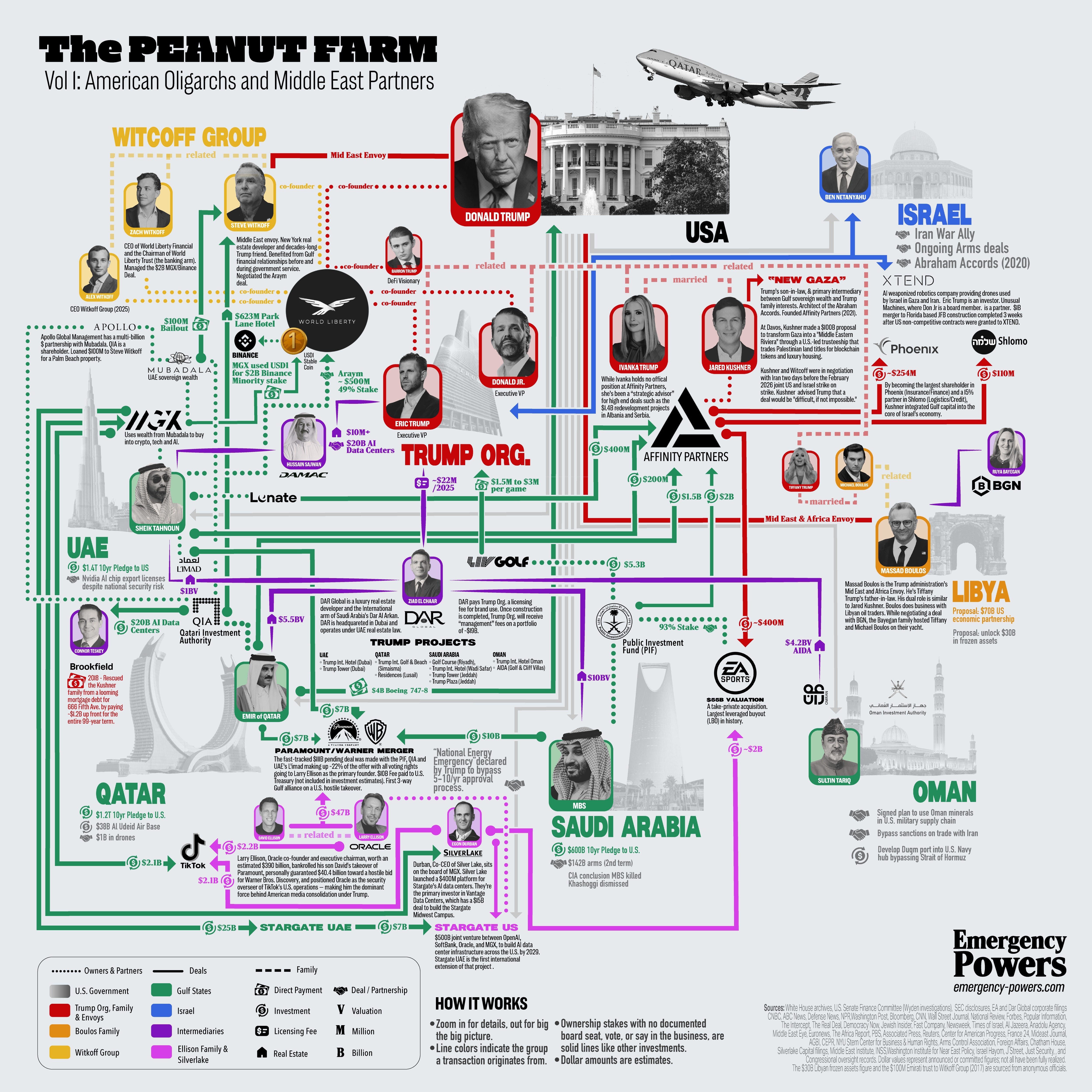
Infographic: Trump and Associates' Middle East Business Deals

A crypto deal signed with an Abu Dhabi royal days before Trump’s inauguration, the Qatari plane gifted to Trump, Nvidia chips approved for sale to the UAE, Don Jr. and Eric Trump’s investments in an Israeli AI drone company, Kushner’s “New Gaza” and business with MBS, the TikTok U.S. sale, the Paramount/Warner Bros. merger, and now the war in Iran. Together, they tell a larger story of corruption that’s easy to overlook when it’s scattered across your feed. The infographic accompanying this piece is an extensive compilation of public records, congressional filings, SEC disclosures, Corporate disclosures, and reporting. You can download the list of citations here.
In February, Trump’s son-in-law and Steve Witkoff, his longtime real estate buddy and Special Envoy to the Middle East, were sent by the U.S. to negotiate a new nuclear deal with Iran. On February 26th, talks failed. 36 hours later, the U.S. and Israel launched a joint military strike on Iran. With no clear reason given to the American public for entering a war with Iran, nor one to get out, conjecture has filled the void.
With that in mind, this is not an argument for why the war began. This data doesn’t provide smoking gun evidence that private financial interests shaped diplomacy. The financial interests exist regardless. Members of Trump’s inner circle are profiting from war. While there is a chance this war could reshape the Middle East in a way that’s favorable to the Gulf States, the longer it continues, and the Iranian regime remains, the less likely that is. If a wider regional crisis unfolds, it could have destabilizing effects or, at a minimum, pose economic challenges. Tourism to the UAE is already taking a significant hit amid Iran’s strikes on targets across the Middle East. A regional refugee crisis, or an Iran now set on obtaining nuclear deterrence, is probably not the return on investment the UAE or Saudi Arabia were hoping for by bankrolling Affinity Partners and World Liberty Financial. Thanks to crypto and Gulf State money, approximately 50% of Trump’s $6.8 billion net worth is tied to foreign investors; there’s no indication he won’t burn them in the process. We’re galaxies away from Carter’s Peanut Farm.
INFOGRAPHIC: HOW IT WORKS
It looks kind of like a microchip. Like a subway map, it may appear overwhelming at first. That speaks more to the sheer number of relationships and transactions. As complex as it may seem, if you sit with it for a minute, it gets easier to navigate. There’s one simple thread — money. Specifically, the money funding the people making American foreign policy in the Middle East. Skimming the summary of oligarchs below is recommended.
Zoom in for details, out for the big picture. Each family or group of actors has been given a color. The gray lines descending from the White House, as well as the gray text under each country, represent U.S. government policy. Line colors indicate the group a transaction originates from. The dashed lines show family relations. Dotted lines are structural ownership and partnerships. Solid lines are deals and investments. While some solid lines denoting investments represent an ownership stake in a company, they’re not dotted if they do not include a board seat, a vote, or a documented say in the business. The dollar amounts are estimates. Some of the deals are pending, some are subject to change.
If you spot a mistake, please let me know. Also, let me know if you find this useful and would like more data visualizations. This took many hours to put together. Your subscription and shares are much appreciated.
THE OLIGARCHS
JARED KUSHNER
Jared Kushner is not a U.S. government official. Neither Jared Kushner nor Steve Witkoff had experience negotiating nuclear deals before they were sent to Geneva to negotiate with Iran on behalf of America.
Shortly after leaving the White House in January 2021, Kushner founded his investment firm, Affinity Partners. A few months later, Saudi Crown Prince Mohammed bin Salman (MBS) invested $2 billion in the firm. The Saudi Public Investment Fund’s (PIF) committee initially rejected it, citing the firm’s lack of experience and portfolio. MBS overruled their objections. Since then, Affinity Partners has collected over $112 million in management fees from Saudi Arabia alone, but has yet to return a single dollar in profit to its investors. Roughly 77% of Affinity Partners’ investor base is Gulf State money.
Kushner’s most recent deal was to broker a $55 billion buyout of Electronic Arts, in which the Saudi PIF acquired a 93% stake in the California-based video game company. Kushner invested ~$400 million in the deal, owning 1-2% when the deal closes in June. The private equity company Silver Lake, which cites David Ellison as a founding investor and is now an owner of TikTok U.S., invested ~$2 billion to own a 4-5% stake of EA.
As the largest shareholder in Israel’s Phoenix Insurance and Finance and a partner in Shlomo Holdings, Kushner integrated Gulf capital into the core of Israel’s economy. Two weeks before his first round of negotiations with Iran, at Davos, Kushner made a $100 billion proposal to transform Gaza into a “Middle Eastern Riviera “ through a U.S.-led trusteeship that trades Palestinian land titles for blockchain tokens and luxury housing.
STEVE WITKOFF
Steve Witkoff is Trump’s Special Envoy to the Middle East. Envoys are appointed by the executive without congressional approval. He has no diplomatic experience, though, as with Kushner, much of his livelihood depends on Gulf State riches.
Witkoff spent nearly three decades building the Witkoff Group into one of New York’s more prominent real estate firms — 75 projects, 18 million square feet, a portfolio spanning Manhattan, Miami, Las Vegas, and Hawaii. In 2013, he acquired the Park Lane Hotel on Central Park South for $654 million, partnering with Malaysian financier Jho Low, who held an 85% stake. The deal became a liability almost immediately. Low was accused of stealing billions in the 1MDB international fraud scandal, and the DOJ filed suit to seize the hotel. In 2019, as Witkoff was faced with a $480 million debt on the property coming due, Abu Dhabi’s sovereign wealth fund, Mubadala, stepped in and bought out Low’s stake for $140 million. That same year, Witkoff refinanced the property with a $615 million loan. Unable to find a buyer at his $1 billion asking price, he sold to Qatar’s Investment Authority (QIA) in 2023 for $623 million with the aid of Mubadala. Two Gulf State sovereign wealth funds, one lucky guy.
In 2024, Witkoff co-founded World Liberty Financial with the Trump family (Donald Trump, Baron, Eric, and Don Jr.), serving as a co-founder emeritus alongside his sons. When Trump appointed him Special Envoy to the Middle East in November 2024, he retained a minority ownership stake in the Witkoff Group. His son, Alex, assumed the CEO position while the White House maintained that he was “finalizing” a divestment. Days before Trump’s inauguration, UAE royal Sheikh Tahnoon bin Zayed Al Nahyan’s Aryam Investment purchased a 49% stake in World Liberty Financial for $500 million. The Witkoff family received $31 million from that transaction. The same Sheikh Tahnoon’s MGX fund later used WLF’s USD1 stablecoin to close a $2 billion investment in Binance — a deal that positions World Liberty to earn an estimated $80 million annually in stablecoin revenue, of which the Witkoff family receives 12.5%. World Liberty Financial made Trump a billionaire.
ZACH AND ALEX WITKOFF
Zach Witkoff is a co-founder and one of three managers running World Liberty Financial's daily operations along with co-founders Barron, Eric, and Donald Trump Jr. At Token2049, the world’s largest crupto conference held in Dubai, he announced the $2 billion MGX-Binance stablecoin deal from a stage alongside Eric Trump, as and moderator crypto billionaire Justin Sun, who had recently invested $75 million in WLF. Changpeng Zhao was also present. He had submitted a pardon request to Trump one month prior to the event. He got one in October 2025, after Binance bought $2 billion in USD1. World Liberty Financial has filed for a national banking license, with Zach listed as president and chairman of World Liberty Trust. In 16 months, the venture generated at least $200 million for the Witkoff family.
Alex Witkoff became CEO of the Witkoff Group after his father’s government appointment. He’s also a co-founder of WLF. In 2024, while his father was actively negotiating with Qatari officials on the Gaza ceasefire, he pitched Qatar’s sovereign wealth fund QIA on a $4 billion real estate credit fund — expected to earn $80 million annually in management fees. Qatar confirmed the pitch and declined. Alex has separately claimed to have secured funding pledges from sovereign wealth funds in Qatar, the UAE, and Kuwait, though no confirmed transactions from those claims are publicly documented. The Witkoff Group has received at least $200 million in Qatar-linked investment through Apollo Trust, a fund partly owned by the Qatari government, entirely separate from the WLF dealings.
Eric and Don Trump Jr.
While their father is in the Oval Office, Eric Trump and Donald Trump Jr. run the Trump Organization — the family’s legacy real estate and licensing business, now expanding rapidly across the Gulf, as co-executive vice presidents. Don Jr. acquires and develops, and Eric operates and manages. They do not hold formal roles in the administration, but their business activities since January 2025 have been extensive and largely conducted in the same countries where their father happens to be negotiating. The relationship with Hussain Sajwani, the Emirati billionaire founder of DAMAC Properties, illustrates how personal these ties run. Sajwani has been a Trump partner since 2013, when DAMAC built the first Trump-branded golf course in Dubai. Eric and Don Jr. attended Sajwani’s daughter’s wedding in 2018. In January 2025, Sajwani stood beside Trump at Mar-a-Lago to announce a $20 billion DAMAC investment in U.S. AI data centers — an announcement that generated over $6 million in fees for the Trump Organization between January 2024 and June 2025. From the stage, Sajwani let it be known that “For the last four years, we’ve been waiting for this moment.”
The Trump Organization has an extensive partnership with luxury real estate developers Dar Global — a subsidiary of Saudi Arabia’s Dar Al Arkan — on a $531 million Trump Tower in Jeddah, two additional Riyadh projects, a luxury golf resort in Qatar built on land owned by the Qatari government, and a $500 million resort in Oman developed alongside Omran, a government-owned Omani group — the same country that hosted the Iran nuclear talks. In May 2025, weeks before their father’s Gulf tour, both brothers were already in the region. Don Jr.’s originally titled talk at the Qatar Economic Forum was called “Monetizing MAGA.” Eric recently announced an 80-story Trump Tower in Dubai. Both brothers are also actively involved in World Liberty Financial’s daily operations.
Drones are a more recent and unsettling thread. Through American Ventures, a Texas-based investment vehicle, Eric and Don Jr. have assembled a drone portfolio Bloomberg values at nearly $750 million — across three companies all pursuing Defense Department contracts under the Pentagon’s Drone Dominance initiative. Eric is a strategic investor in Xtend, an Israeli AI drone company whose systems are being used by the Israeli military in Gaza and Iran. On February 17, 2026 — eleven days before the U.S. and Israel struck Iran — Xtend and JFB Construction Holdings announced a $1.5 billion merger, with Eric named as a strategic investor. The deal was signed while Witkoff and Kushner were still at the negotiating table in Geneva. In early March, as the conflict widened, Xtend announced it had mobilized its global XFAB operator network to support allied defense missions at the request of Israel’s Ministry of Defense.
Don Jr.’s drone interests run through additional channels: an advisory board seat at Unusual Machines, whose largest Pentagon contract came after his appointment, and a major stake in Anduril through his venture firm, 1789 Capital. Both brothers are invested in Powerus, a newly formed manufacturer pursuing production of more than 10,000 drones per month, taken public through a reverse merger with a Florida golf course company — a structure one defense analyst called “essentially a front.” The Pentagon wants 340,000 drones. The Trump family is positioned to supply them.
Larry Ellison, David Ellison & Egon Durban
Larry Ellison co-founded Oracle in 1977 with a CIA contract. One of the richest men in the world, he briefly surpassed Elon Musk on the Bloomberg Billionaires Index in 2025. He currently lives twenty minutes from Mar-a-Lago and is a frequent White House guest. In January 2025, he stood beside Trump to announce Stargate, a $500 billion AI infrastructure initiative for which Oracle is a cornerstone investor. To fast-track the process, Trump declared a “National Energy Emergency,” thereby bypassing the standard 5-10-year federal approval process.
Oracle’s Gulf State exposure is substantial and growing. The company is the lead managing investor and data security overseer of TikTok’s restructured U.S. joint venture — a $14 billion deal in which Abu Dhabi’s MGX holds a 15% stake alongside Oracle’s 15%, structured to keep the transaction out of CFIUS review. Analysts estimated TikTok’s U.S. operations were worth $30–35 billion at the time — meaning the consortium acquired it at roughly half its market value. Oracle is also the backbone of Stargate’s AI data center buildout, which is being funded in part by UAE sovereign capital. Through it all, Ellison has operated with a lower profile than Musk or Zuckerberg, letting the deals speak.
Trump also fast-tracked regulatory approval for David Ellison’s $8 billion acquisition of Paramount Skydance — a deal that required Paramount to settle Trump’s $16 million lawsuit against CBS’s 60 Minutes as a condition of regulatory approval. David then immediately pursued Warner Bros. Discovery, assembling a financing consortium that included $24 billion from the sovereign wealth funds of Saudi Arabia ($12B via PIF), Qatar ($7B via QIA), and Abu Dhabi ($7B via L’imad Holding) — the largest proposed foreign-backed investment in U.S. media history, structured to avoid CFIUS by stripping the Gulf funds of governance rights and board representation. The Warner Bros. board ultimately chose Netflix’s competing bid, which carried no foreign financing. Paramount then launched a hostile takeover, with Larry Ellison personally guaranteeing $40.4 billion. It worked. Paramount acquired Warner Bros. Discovery in February 2026 for $31 per share — $111 billion total.
One family, backed by Gulf sovereign capital, is now set to control CBS, CNN, HBO, Warner Bros. Studios, Paramount+, and TikTok. CNN has not yet adjusted its editorial direction. Time will tell whether ownership is destiny.
Silver Lake’s Egon Durban is the thread that stitches this group together. The connection between Silver Lake and the Ellison family goes back to the firm’s founding. Silver Lake was co-founded in 1999 by David Roux, the former Executive Vice President of Oracle, who described Larry Ellison as a defining influence. Ellison was one of Silver Lake’s first and most significant investors, lending his name to the firm’s fundraising when it launched its debut fund.
Egon Durban sits on the board of TikTok’s U.S. joint venture alongside Oracle, holds a 15% stake in the new entity, and has been described as having close business ties to Jared Kushner. Silver Lake was also a co-investor alongside Saudi Arabia’s PIF in the $55 billion EA buyout — the largest leveraged buyout on record — which Kushner personally brokered. In deal after deal — TikTok, EA, Paramount — the Ellison family and Silver Lake are together, often alongside the same Gulf sovereign wealth fund.
Gulf State Royals and Leaders
These are the counterparties. The sovereigns and their wealth funds whose names appear throughout every deal on this map.
Mohammed bin Salman (MBS) — Crown Prince of Saudi Arabia. He’s the architect of Vision 2030, Saudi Arabia’s plan to diversify its economy beyond oil. The sovereign wealth fund he controls, the Public Investment Fund (PIA), has pledged $600 billion in U.S. investments over four years. That fund is the lead buyer in the EA deal, a primary backer of the Paramount/Warner bid, and the source of the $2 billion that seeded Kushner’s Affinity Partners six months after he left the White House. The CIA concluded MBS ordered the killing of Washington Post journalist Jamal Khashoggi in 2018. Trump dismissed his own government’s conclusion.
Sheikh Tahnoon bin Zayed Al Nahyan — UAE is the UAE’s national security advisor, manager of its largest sovereign wealth fund, and the man behind Aryam Investment — the entity that purchased a 49% stake in World Liberty Financial for $500 million days before Trump’s inauguration. His state-backed MGX fund used WLF’s USD1 stablecoin to close a $2 billion investment in Binance, holds a 15% stake in TikTok’s U.S. joint venture, and has committed $1.4 trillion in U.S. investments over the next decade. Shortly after the Aryam deal, the Trump administration approved the sale of hundreds of thousands of advanced Nvidia AI chips to the UAE — chips that had previously been restricted on national security grounds.
The Emir of Qatar — Sheikh Tamim bin Hamad Al Thani leads the country that served as the primary mediator in the Gaza ceasefire negotiations, hosted multiple rounds of Iran nuclear talks, purchased the Park Lane Hotel from Witkoff for $623 million, invested $200 million in Witkoff Group real estate through Apollo Trust, committed $1.2 trillion in U.S. investments, and gifted Trump a $400 million Boeing 747-8. Qatar’s Investment Authority is also a financing partner in the Paramount/Warner bid. The Emir of Qatar attended Alex Witkoff’s wedding in Palm Beach in early 2024. Later that year, he sat with Steve Witkoff in Doha as ceasefire negotiations with Hamas continued.
Sultan Haitham bin Tariq — Oman is the absolute monarch of a country that has quietly become indispensable to American diplomacy in the region. Oman hosted every round of the Iran nuclear talks, brokered a 2025 Houthi ceasefire, and maintains open channels with both Saudi Arabia and Iran simultaneously. The Trump Organization has made a 30-year deal with Sultan Tariq to design, build, and manage a $500 million luxury resort on government-owned land, with Oman taking a cut of the profits. The NYT’s Eric Lipton, who has investigated Trump family international deals since 2016, said he had never seen a conflict of interest potential like the Oman deal. Oman has also signed agreements to develop the Duqm port into a U.S. Navy hub and to bypass the Strait of Hormuz — the same waterway Iran has currently shut down.
The Intermediaries
These are the deal mechanics — the developers, asset managers, and energy traders through whom Gulf capital and Trump family interests move into physical form.
Ziad El Chaar’s — Dar Global is the most consequential. A subsidiary of Saudi Arabia’s Dar Al Arkan, it is the primary vehicle through which the Trump Organization is expanding across the Gulf — licensing the Trump name, collecting management fees, and developing luxury real estate in Saudi Arabia, the UAE, Qatar, and Oman without the Trump family investing a dollar of their own money. Six active projects at last count, with more announced. El Chaar has said publicly that there is more to come.
El Chaar told Reuters in January 2026 that the Trump-Dar Global projects together are valued at around $10 billion. The Trump Organization collects licensing and management fees on all of it without investing a dollar of its own capital. Dar Global's purchase of Trump name rights alone generated $21.9 million for the Trump family in 2024.
Hussain Sajwani’s — DAMAC is where the Trump-Gulf relationship began. The first Trump-branded golf course in the Middle East opened in Dubai under DAMAC in 2017. Eric and Don Jr. attended Sajwani’s daughter’s wedding. He announced a $20 billion U.S. data center investment from Mar-a-Lago in January 2025, standing beside Trump onstage. The Trump Organization has earned more than $6 million in DAMAC-related fees since 2024 alone.
Connor Teskey’s — Brookfield is the quietest entry but carries the most historically loaded thread. In 2018, Brookfield paid $1.28 billion for a 99-year lease on 666 Fifth Avenue — rescuing Kushner Companies from debt that was coming due. Qatar’s sovereign wealth fund was Brookfield’s second-largest investor at the time. Brookfield told Congress Qatari representatives had no involvement in the deal. Congress investigated. The Saudi blockade of Qatar was lifted shortly after the transaction closed. Brookfield has stonewalled Senate inquiries ever since.
Ruya Bayegan’s BGN International rounds out this group and connects directly to the Boulos section below — a Libyan oil trader whose yacht hosted Tiffany Trump and Michael Boulos while Massad Boulos was negotiating Libyan energy deals in Tripoli.
Massad and Michael Boulos
Libya is not the Middle East. It’s North Africa, and this inclusion is a footnote to the main story rather than a central thread. But the structural parallel is worth noting: Massad Boulos is Trump’s Senior Advisor for Arab Affairs and Africa, and his son Michael is married to Tiffany Trump — the same architecture as Kushner. A family member becomes an envoy, the envoy conducts diplomacy, and diplomacy overlaps with business.
In July 2025, while Massad was in Tripoli announcing deals to increase Libyan oil and gas production, Tiffany Trump and Michael Boulos were cruising the French Riviera aboard the Phoenix 2 — a 300-foot superyacht owned by Turkish oil traders Ercument and Ruya Bayegan. Ruya Bayegan’s energy company, BGN International, stands to directly benefit from any increase in Libyan oil production. The family did not pay for the trip. Libyan officials have taken to calling Massad “Abu Tiffany” — Tiffany’s father. The Trump administration has separately discussed unlocking tens of billions in Libyan assets frozen since the 2011 NATO-backed uprising and channeling a portion back to U.S. companies — an arrangement that could violate UN Security Council sanctions.


