
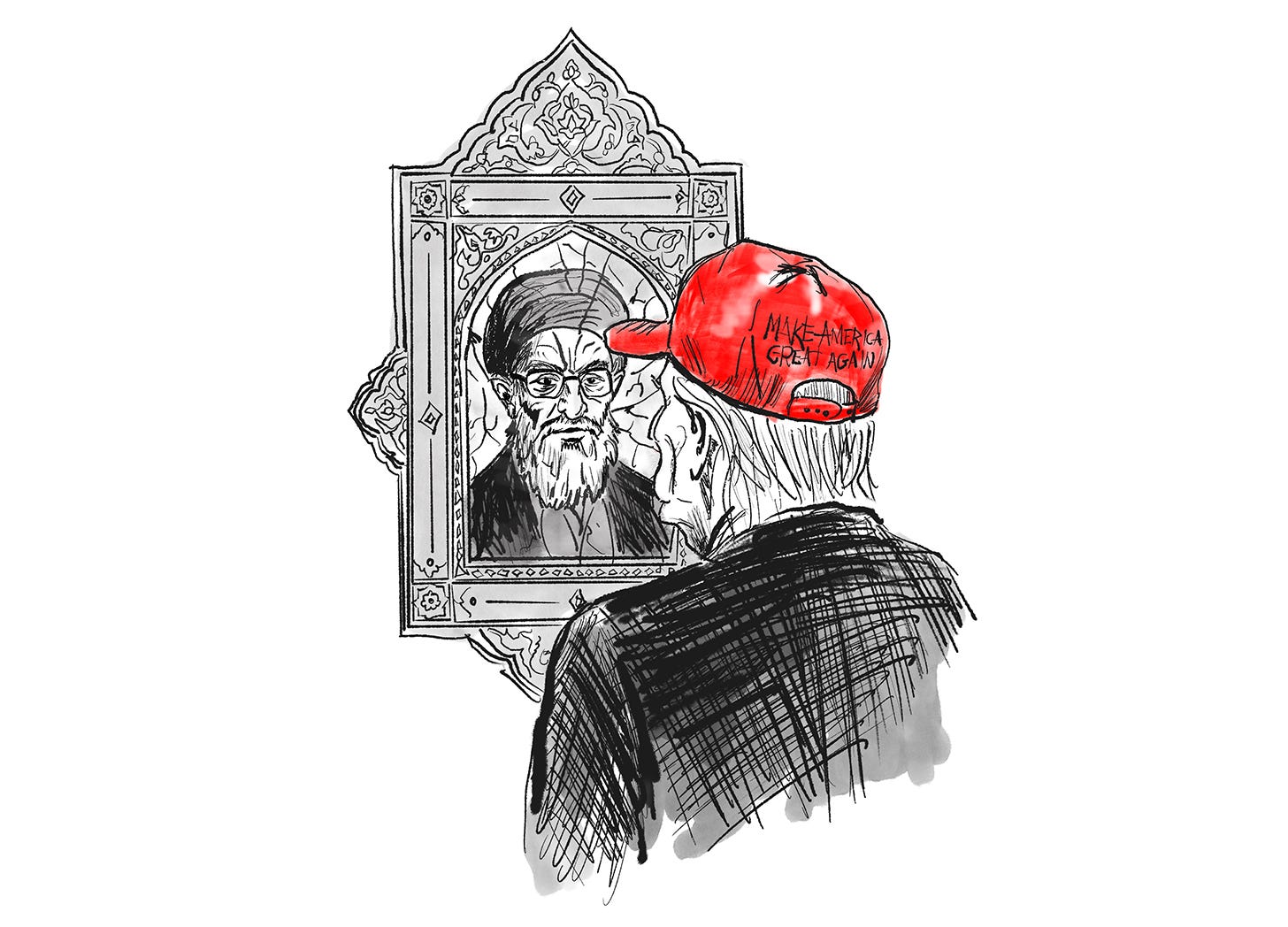
Khamenei Is Dead, Theocracy Lives
When the Enemy of Your Enemy Becomes Your Strongman
The morning after Ayatollah Khamenei was killed, thousands of mourners gathered in Tehran’s Enghelab Square and towns throughout Iran, Iraq, India, and Lebanon. In Pakistan, protesters stormed the U.S. consulate, leaving at least 21 people dead. There’s a peculiar sadness in public tears for a theocratic tyrant. A conditioned lamentation on which decades of survival rely. It’s the role-playing that ratifies the cyclical dependency of subjects to the brutality of their strongman.
Others welcomed Khamenei’s final breath. I am one of them. He was the kind of man who gives the word “evil” its weight. It’s moving to watch Iranians dancing in the streets, uncertain of the future, hoping it’s better than the past. I’m inspired by the young women, taking a moment to let their hair down, knowing thousands have been killed for subtle acts of defiance. A couple of months ago, the Iranian teens on the sidewalk, playing a cover of the White Stripes’ “Seven Nation Army,” reminded me of my own rebellious youth, though the stakes for us were nowhere near as high. While much is uncertain, it’s clear there is more than one Iran.
My thoughts are also divided. Early into the Syrian War, I assisted a U.S.-Syrian advocacy group in verifying photos from the Homs countryside, where Hezbollah death squads — funded and armed by Iran — massacred villagers of all ages and left piles of bodies to rot under the summer sun. Similar campaigns were carried out in rural towns such as Nubl and al-Zahraa, the Qalamoun Mountains, and the countryside of Daraa and Quneitra. This tipped the war in Assad’s favor. When the Free Syrian Army began to tip the balance back, Iran supplied the Assad regime with ground troops. Iran’s ally, Putin, provided the air force.
Khamenei’s record of terrorism and war crimes is extensive. The regime’s repression is renowned. Over 7,000 protesters have been killed since December, with independent reporting suggesting the toll may be exponentially higher. Iran executed over 2,000 people in 2025 — the highest count since the late 1980s.
The Iranian regime is at its weakest point since its inception. Pushed out of Syria, and with Hamas and Hezbollah significantly reduced, their grip on the region is arthritic. Tehran’s sporadic retaliation against the Gulf States has only united them against Iran. Iran is a large country with a population of 92 million. Its regime is a vast bureaucracy with a powerful military and state police apparatus for which the 86-year-old cleric, in ill health, had become a mere figurehead.
Taking out the top brass doesn’t guarantee regime change. The I.R.G.C. is close to appointing another to succeed Khamenei's black amama, with his son Mojtaba Khamenei as a main contender. Many civilians will lose their lives in this conflict. Without foreign military intervention, Iranian suffering will likely persist. However, war remains unpredictable. There’s no guarantee of a positive result even with the sharpest minds in charge, and they’ve been replaced by TV personalities.
As easy as it is to assert an argument for regime change, the administration has failed to. Trump’s aptly named operation, “Epic Fury,” was launched without Congressional authorization, a UN mandate, or a plan for what follows. It was ordered by a president who governs by executive decree, rolls out the red carpet for Putin, and expresses open admiration for the kind of strongmen Iranians have spent decades trying to escape. In urging Iranians to rise up, he’s given them a spark with no oxygen. That Trump is the instrument of their possible liberation is one of this moment’s less subtle ironies. By most legal definitions, the man who killed a war criminal is one himself.
A week before the U.S. and Israel embarked on a war against a theocratic regime, Secretary of Defense Pete Hegseth claimed we’re part of one. At the National Religious Broadcasters convention in Nashville, he stood before thousands of Christian leaders and media outlets and declared that protecting America’s religion from godless ideologies was not political; it was biblical. The U.S. is a Christian nation.
On Tucker Carlson’s show, Mike Huckabee, U.S. Ambassador to Israel, said Israel has a biblical right to the land stretching from the Nile to the Euphrates. They have a right to “take it all.” This echoed his earlier statements, implying Trump had biblical authority to nuke Iran. Khamenei spent his career making similar claims under divine authority.
As the administration spins the wheel of possible justifications for U.S. intervention, in the first 48 hours of the assault, the watchdog group Military Religious Freedom Foundation received over 110 reports from U.S. military personnel stationed in the Middle East that leadership is calling this a holy war. One officer reported their commander had been “urged to tell our troops that this was ‘all part of God’s divine plan’ and he specifically referenced numerous citations out of the Book of Revelation referring to Armageddon and the imminent return of Jesus Christ.”
Years ago, I accompanied a group of U.S. Syrians to meet with Congressman Alan Lowenthal, then a member of the House Foreign Affairs Committee. The discussion covered a wide range of issues affecting the Syrian diaspora, American Muslims, and U.S. policy on Syria. A couple of attendees had lost family in the chemical weapons attacks in which the Obama Red Line was crossed. They were disheartened that Congress voted against taking action. That frustration grew over the years with countless meetings and demonstrations where they were told help was on its way, only to find them as effective as thoughts and prayers.
When we left, I was in the elevator with a Syrian dentist who became a U.S. citizen shortly after the Arab Spring. As we descended to the parking garage, he began to shake. I asked if he was alright, and tears welled up. In the confines of a windowless box, he told me he’s never shared his political opinions with anyone outside his closest friends and family, let alone with a government official. He knows this is America, and he has freedom of speech. It’s why he came here. But he couldn’t escape the feeling that if what he said in that office was viewed as disagreeing with the government, he and his family could pay in blood for what he had just done.
Autocracy is abusive. The PTSD lingers. Facing it makes democracy a courageous act. It’s inspiring to witness. Though when Syrian Americans I stood with advocating for democracy on the steps of the Lincoln Memorial used their vote to elect Trump in 2024, I understood that survival doesn’t mean escape. From the assassination of Qassem Soleimani to supporting Ahmed al-Sharaa’s new Syrian government, they’ve come to view Trump as a man of action in the Middle East, while Democrats sit on their soft hands.
Trump’s raid in Venezuela and now Operation Epic Fury only solidified that. They know it’s illegal; they don’t care. America has a militarized police force patrolling the streets, free to racially profile or kill without due process. But troubles at home have yet to rise to the frequency they’ve seen elsewhere. I would be remiss to equate the Arab and Persian experience, and would be rightly and quickly corrected by both diasporas. Though there’s a cross-section who share a growing admiration for the Trump regime. Their life in Trump’s America is significantly better than it would be under Assad or Khamenei. When the slow process of democracy appears to suppress action rather than be a means of it, some will vote to make the enemy of their enemy their strongman.
Authoritarian leaders have long used foreign wars to suppress the vote and consolidate power at home. They frame it as protecting voters from fraud, foreign intervention, and terrorism. Considering the response to ICE, I’m hopeful Americans will stand up to such overreach. Though there will be scapegoats greasing the administration’s gears before votes are cast.
The war in Iraq spread a fear of Muslims throughout America that Trump leveraged in his 1st term to court his base with the Muslim ban. In his second term, he’s empowering Christian nationalists and their message of moral superiority in the lead-up to a new Middle East war. Middle Eastern Americans and Muslims cheering Epic Fury today should not forget how the autocratic pendulum swings.
Trump courted Latino voters in 2024, which helped him win the election. He then sent ICE into their neighborhoods. The longer this war goes on, the more likely Middle Eastern Americans find they’re not outside that pattern. They make up roughly 1% percent of the U.S. electorate, a third of whom voted for Trump in 2024 — not enough to compensate for his declining approval. If a pivot to frame them as a terrorist threat could land Trump more votes, or is useful in suppressing votes, he may do so. Cheers and tears won’t help. A strongman who fights your enemy has a history of deciding, when it’s useful, that you are one too. Like America, the kids rocking in the streets of Tehran deserve better than that calculation.


