

The Pentagon's Procurement Racket
Inside Deal Team Six, the Trump defense portfolio, and the China policy built around them

Authoritarian consolidation runs on spectacle — the image of power is substituted for power itself until the image is all that many see. Putin’s shirtless horseback rides and judo demonstrations reduced a surveillance state to a personality cult. As people loved or mocked the photo op, the scaffolding went up. Orbán raised a football stadium in his hometown while quietly annexing the courts and the press. Erdoğan built a thousand-room palace and wrapped his constitutional rewrite in the pageantry of Ottoman restoration. The spectacle is a shell. Once they’ve taken your attention, they install the system that takes your money.
The Trump administration’s spectacle leans into cartoon villainy. It’s half-cavalier performance, half-obliviousness. At the moment, the President’s most vocal domestic priority is the construction of the White House ballroom, beneath which sits an underground bunker he’s now insisting requires a billion dollars in taxpayer money to secure properly. Prior to posting images of himself as Jesus, he AI-slopped himself as Thanos and a Sith Lord. Kash Patel appropriated the Punisher logo for his personally branded Nikes. Last week, at a White House press briefing, Pete Hegseth could neither confirm nor deny that the U.S. military has kamikaze dolphins in its arsenal. Elon Musk took to the stage, wielding a chainsaw to celebrate the dismantling of USAID, which resulted in an estimated 750,000 deaths last year, according to infectious disease modeler Dr. Brooke Nichols. I could list the rest of the Legion of Doom, but you get the picture.
Cloaking corruption in the cosplay fictional villainy has the convenient effect of making anyone who takes it seriously look like they’re reading too much into a meme. It also distracts from their perpetual failure and disregard for consent, which is more akin to Wile E. Coyote and Pepe Le Pew. The president’s sons are no exception.
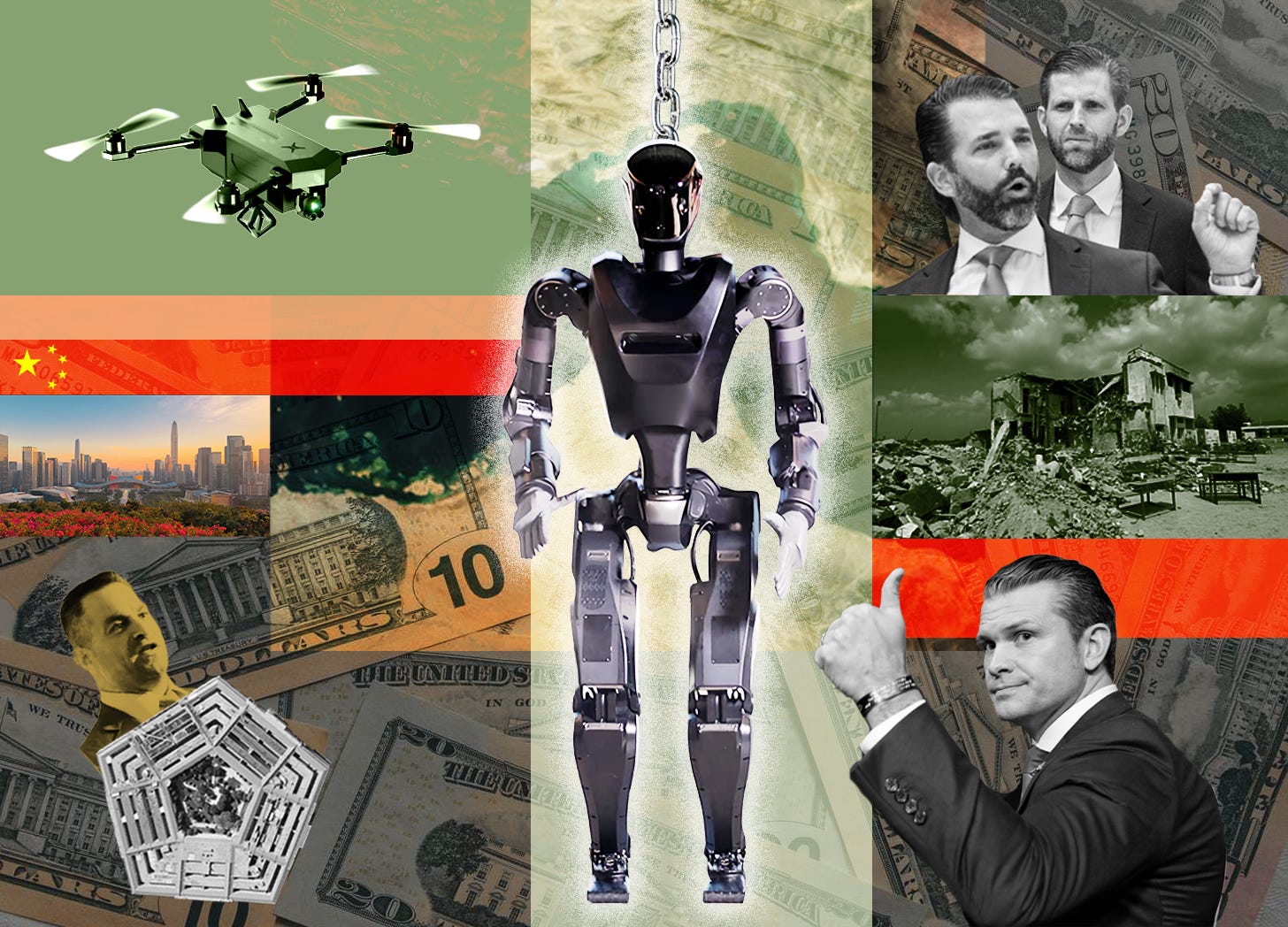
On April 23rd, Eric Trump, the new Chief Strategy Advisor for Foundation Future Industries (FFI), joined CEO Sankaet Pathak on Fox Business to celebrate the startup’s $24 million in Pentagon contracts with Maria Bartiromo. The contracts were secured six weeks after Eric Trump joined the company. Behind Pathak stood the startup’s autonomous humanoid combat robot, Phantom Mk-1, with a support chain rising from its back.
Eric Trump, who, like Cobra Commander, goes on TV when silence would serve him best, grinned as he explained to Bartiromo his qualifications for building the world’s most advanced robot army, “I got involved with crypto in a very big way because we had to win that digital revolution. We have to win robotics in the United States of America.” It would be amiss not to wonder who Eric Trump is referring to when he says “America.” Sadly, no follow-up question was asked about how the Trumps’ crypto venture, World Liberty Financial — 49% owned by the UAE’s Sheikh Tahnoun — is winning the digital revolution for the U.S.
Pathak claimed that the next iteration of his robot, the Phantom MK-2, would be revealed in the coming months and would be unlike “anything in the world.” Then he brought up Anthropic. The Pentagon's policy requires AI vendors to allow the military to use their models for mass surveillance of Americans and for autonomous killing. Anthropic wouldn't agree to it. So Hegseth designated the company a "supply-chain risk to national security" — a category normally reserved for foreign adversaries — and ordered defense contractors to stop doing business with it. Pathak used his time on Fox News to call the Pentagon's position "reasonable" and said Anthropic "fell on its face." The signal of loyalty to his CSO’s father and the Secretary of Defense was unmistakable.
To justify FFI’s contracts, Pathak told Bartiromo that “zero startups” in the U.S. are working on humanoid robots for defense use and that they welcome competition. FFI isn’t the only U.S. company in the rapidly expanding humanoid space, nor is combat the only military application for robotics. While several robotics companies have pledged not to allow their robots to be used for combat, what most distinguishes FFI as a “defense” humanoid company is the contract itself, which speaks more to their lack of ethics than to their product.
In an NBC Bay Area report, Phantom MK-1 struggled to walk. A reporter pushed its chest, it seized and fell over. Time reported the same issue. If there was any mistaking the robots’ lack of readiness, you can watch it slip on banana peels. FFI is ostensibly behind the leading U.S. humanoid robotics companies and their Chinese competitors in basic mobility. The industry is in its early phase, with dozens of companies competing to lead the market. It will be years before humanoid robots can perform many of the tasks they’re designed for. So if the U.S. is expanding industrial policy, how is it determining which startups it believes will be “winners” and not the “losers” that go under, costing taxpayers millions, like Solyndra and Foxconn?
FFI has produced approximately 40 robots, including one deployed in an Atlanta automotive facility. The company’s stated milestones require scaling to 10,000 units by the end of the year and a cumulative 50,000 by late 2027—a 250-fold expansion over twenty-four months. The underlying capital suggests a structural ceiling well below these figures. At a current manufacturing cost of $150,000 per Phantom Mk-1, allocating the entirety of FFI’s $21 million in private seed capital strictly to production—leaving nothing for operations, engineering salaries, or facility overhead—yields just 140 units. Incorporating the recent $24 million Pentagon grant extends that theoretical maximum to 300 robots.
By comparison, Figure AI has raised $1.75 billion in institutional capital, backed by a major technology syndicate, to build the specialized infrastructure necessary to target an annual production of 12,000 units. Nevertheless, by January 2026, months before FFI’s modest defense research grants were finalized, it was already leveraging these manufacturing targets to pitch institutional investors on a $500 million capital raise at an aspirational $3 billion valuation.
In April 2024, Pathak’s former company, Synapse Financial Technologies, filed for Chapter 11 bankruptcy. Synapse was a fintech banking-as-a-service platform that acted as the intermediary between financial apps and the banks that held their customers’ deposits. The collapse locked more than 100,000 Americans out of $265 million in customer balances. At a creditor hearing, Pathak acknowledged that Synapse may have commingled customer funds — pooling end-user deposits, FinTech reserve funds, and Synapse’s own operating funds — in accounts at its partner banks. The court-appointed bankruptcy trustee, former FDIC Chair Jelena McWilliams, reported that Synapse indeed had commingled customer funds across multiple partner banks, leaving a shortfall of up to $95 million that she could not account for.
McWilliams told the court the system had “failed so many end users in so many ways.” By early 2025, the DOJ’s Southern District of New York had convened a grand jury to investigate potential accounting and wire fraud related to the collapse. The same month the bankruptcy was filed, Pathak launched Foundation Future Industries. Pathak has not been charged with any wrongdoing.
Within two months, Pathak was fundraising for FFI, claiming in marketing materials that General Motors was an investor and had placed a $300 million purchase order. GM denied it flatly. FFI co-founder Mike LeBlanc, a former Marine and the only co-founder with a military background, confirmed GM’s denial and said he was embarrassed that the fabricated materials existed. Such a track record would deter most business relationships, but not the Trumps or the Pentagon.
What FFI’s Phantom MK-1 demos show, and the production numbers confirm, is that they were not awarded DoD contracts across the Army, Navy, and Air Force based on any measurable merit or business acumen. But now that they have them, they can be used as a credential to court investors, rather than lying about GM being one.
The Pentagon recently announced its proposed fiscal 2027 budget: $1.5 trillion, the largest in American history and a 42% increase over the previous year. Within it, the Defense Autonomous Warfare Group (DAWG), established to develop and deploy unmanned autonomous systems, would receive $55 billion, up from $225 million the year before — a 240-fold increase in a single fiscal year. Foundation Future Industries was named in the budget document as a beneficiary.
FFI is one of seven companies in the defense portfolio that have been acquired by the president’s two adult sons since their father’s second term. The acquisitions began in November 2024, when Donald Trump Jr. became a partner at the venture capital firm 1789 Capital. Within a year, four of the firm’s portfolio companies secured federal contracts totaling more than $735 million. He told the Financial Times he was “very involved in the strategic decisions regarding where to invest.” The portfolio included Anduril Industries, which makes unmanned combat systems; Firehawk Aerospace and Unusual Machines, which together secured Air Force rocket engine contracts and an Army drone motor order for the 101st Airborne; and Vulcan Elements.
Vulcan produces rare-earth magnets used in drones, radar systems, and guided missiles. They have 30 employees, fewer than the average McDonald’s location. Yet in late November 2025, the Pentagon’s Office of Strategic Capital issued the company a $620 million loan, the largest the office has ever made — so large it exceeded Vulcan’s valuation at the time of the award. Democrats on the House Natural Resources Oversight and Investigations Subcommittee sought to subpoena Don Jr. to testify under oath about the loan. Republicans voted 5-2 to block the subpoena.
As I previously reported, on February 17th, 11 days before the United States and Israel attacked Iran, Eric Trump was named an investor in Xtend, an Israeli AI drone company that had received a multimillion-dollar Pentagon contract three months earlier from the very people his brother had vetted. Six weeks later, both brothers were named as investors in Powerus, a drone-interceptor company. Both Xtend and Powerus announced plans to go public in the summer of 2026, but not through an Initial Public Offering. Instead, they opted for a reverse merger.
A reverse merger allows a private company to acquire a public stock listing by purchasing a defunct corporate shell, bypassing the prospectus, SEC pre-clearance, and investor scrutiny required for a standard IPO. The disclosures — including those about major investors and their conflicts of interest — are dramatically reduced. The procedure is legal.
Xtend’s shell was JFB Construction, a Florida contractor known for building OrangeTheory Fitness gyms. Powerus’s was Aureus Greenway Holdings, a Nevada-based entity whose principal assets were two golf clubs in Orlando. Both reverse mergers were arranged by the same investment bank, which is also the co-placement agency for Unusual Machines’ stock offerings, Dominari Securities. Dominari operates out of Trump Tower. These drone companies are unrelated on paper, yet within 45 days, they came down the same procedural pipeline.
The reverse-merger architecture went up around the same time the joint investment firm through which both brothers hold many of these positions, New American Acquisition 1 Corp, filed its registration paperwork. It said, in plain language, that the firm intended to invest in companies seeking federal grants. After the AP inquired about that language, Trump’s chief business lawyer filed an amended document. They made a new filing identical to the old one, except the reference to federal grants had been removed. The firm still invests in companies seeking federal grants. It was just conveniently edited to no longer admit it on paper.
With the ongoing war in Iran, the Gulf States have found themselves ground zero for Iranian retaliation. They needed drone interceptors, and the Trump family is selling them. Twenty-four hours before the war began, Xtend gave the Pentagon a demo outside Palm Springs at an event titled “Disruptors in the Desert.” Within three days from the launch of Operation Epic Fury, they were mobilized across the Gulf. In April, Powerus toured the Gulf and, by the end of the month, had secured an Air Force weapons procurement order.
In a kleptocracy, it’s shells all the way down.
China and the U.S. are competing to build the technologies that will shape the global economy. “A cold war is genuinely a good thing,” FFI’s Sankaet Pathak told Time, “because it forces everybody to innovate at a very fast pace.”
The U.S. leads in frontier model development and AI chip design, but that advantage is less stable than it appeared two years ago. DeepSeek R1 challenged the assumption that frontier AI capabilities require the kind of infrastructure investment that only U.S. labs can sustain. China leads in manufacturing. According to the International Energy Agency, China controls approximately 60% of global rare-earth mining and 91% of separation and refining — the processing stage that turns raw ore into the high-performance magnets used in motors, actuators, robotics, and weapons systems.
In China, state capital flows simultaneously into vertically integrated military and commercial production, enabling coordination across the full stack in ways the U.S. procurement system cannot. This allows China to drive down costs, scale up production, and absorb technological risk at a pace that’s extremely difficult for a fragmented contracting regime to match. The U.S. policy response has been muddled.
On December 23rd, 2025, a ban on the sale of Chinese drones in the U.S. took effect on national security grounds. At the time, Chinese drone companies DJI and Autel held 80% of the U.S. domestic market. The Trump administration’s FCC used that review to expand the restriction to all foreign drone manufacturers. DJI wrote directly to Hegseth months earlier, welcoming scrutiny and offering full transparency for a comprehensive review.
No comprehensive review occurred. The FCC’s own fact sheet did not detail the security evidence behind the expansion. Instead, it announced that the commission would “work closely with U.S. drone makers to unleash American drone dominance.”
The national security framing would’ve been more persuasive if applied consistently. In 2024, Chinese state-affiliated hackers known as Salt Typhoon penetrated nine major American telecommunications networks — including Trump’s own phone — accessing the wiretap infrastructure used by U.S. law enforcement. Senate Intelligence Committee Chairman Mark Warner called it the worst telecommunications hack in American history. On his first day in office, Trump disbanded the Cyber Safety Review Board investigating the breach. Sanctions against Beijing were paused for trade talks. TikTok was banned on national security grounds, then extended five times until Larry Ellison’s consortium secured the deal. Advanced Nvidia AI chip exports to the UAE were approved despite documented ties between Emirati state firms and China’s military industry.
A serious response to China’s manufacturing advantage requires sustained commitment across every layer where the gap is widest: industrial policy to build domestic capacity, R&D investment to maintain the research lead, allied coordination to avoid fighting the supply chain battle alone, and immigration policy that doesn’t drive technical talent trained in American universities out of the country. Instead, the administration has relied on blunt tools like tariffs, been hostile toward allies and universities, and denied regulatory clearance to foreign competitors — all while routing capital to companies connected to the president’s family. It’s a China policy calibrated to what Trump can extract from the oligarchs who stand to gain from it.
U.S. policy toward China can also reshape domestic industry. The DoD has drone contracts with companies outside the Trumps’ portfolio. Skydio is the largest U.S. drone manufacturer by revenue, at $180 million in 2024, with a $4.4 billion valuation. Over 50% of its business is with the DoD. AeroVironment is generating nearly $473 million in quarterly revenue and has a $1.1 billion backlog. The process that produced those businesses was competitive. Red Cat Holdings beat Skydio in November 2024 for the Army’s Short Range Reconnaissance Program of Record, a five-year deal potentially worth $260 million.
The Trumps’ drone portfolio took a different route. Instead of competing at the bidding stage, Eric and Don Jr. bought into companies that were already holding or pursuing federal contracts and expanded them through mergers. This coincided with the launch of the war with Iran, which accelerated foreign demand. With restrictions on foreign-manufactured drones in the U.S., 80% of the domestic market was cleared, opening it to companies capable of scaling to fill the void. Eric and Don Jr. are taking advantage of the opening.
This week, Trump arrived in Beijing for a summit with Xi Jinping. He was accompanied by Pete Hegseth, Marco Rubio, and a delegation of 18 leading CEOs in tech, finance, and aerospace, including Elon Musk, Tim Cook, Jensen Huang, and the chief executives of BlackRock, Blackstone, and Goldman Sachs. Each with business depending on what Trump trades with Xi. Xi warned that any foreign interference with Taiwan — home to TSMC, which fabricates the chips that underpin the U.S. AI advantage — could trigger “clashes and even conflicts” between the two countries. Trump made no commitment either way.
Trump campaigned on Hunter Biden’s joining his father on Air Force One for a trip to China, using it as a punchline for corruption. When Trump arrived in Beijing, on the tarmac beside him was his son Eric, whose defense portfolio runs on the same rare earths that were on the table, claiming he was only along for the ride to “keep his dad company.”
Don Jr.’s involvement with the administration is not limited to investments. In September 2025, he boasted on his own podcast that he’s been helping vet candidates for senior Pentagon positions, assessing their ideological alignment with his family’s portfolios. The Pentagon officials who would award the contracts that 1789 Capital’s portfolio companies have, in part, been selected by 1789 Capital’s most prominent partner.
The potential corruption of an individual contract would historically be a scandal in its own right. This administration is integrating that potential into the procurement process. A bribe presupposes that the buyer and the seller are different people. When the buyer has been chosen by the seller’s beneficiary, the question of whether money has changed hands becomes the wrong question. The money is already where it needs to be.
The procurement mechanisms that might have caught any of this have since been replaced by the newly created Economic Defense Unit. It’s staffed with undisclosed private-sector negotiators tasked with displacing the career acquisition officials who had previously managed defense contracts. The new unit has embraced the nickname “Deal Team Six,” a cheeky play on “Seal Team Six” that it adopted from an X post about the unit. In a bizarre AI-animated video, Pete Hegseth asserts that the new unit will save taxpayers’ money by replacing the “bureaucracy” with a group of private-sector elites.
Since the post-Cold War consolidation of the 1990s, the Pentagon has relied heavily on five prime defense contractors during peacetime. The lack of competition has caused bloat and inefficiency. Notably, the F-35 program office employed 2,200 people while delivering every single jet late. Missile production has bottlenecked. There’s a valid argument for procurement reform.
The initial proposal for Deal Team Six resembles Biden’s CHIPS program, which integrated investment bankers into government procurement. However, while the CHIPS program brought in analysts from Goldman Sachs to advise government officials, Deal Team Six is being structured and run by private-sector actors who could potentially be its personal beneficiaries. The alleged aim of saving taxpayers’ money is at odds with a lack of transparency and the request for a 42% increase in the Pentagon’s budget. It could also further undermine the capacity to compete with China.
While the Pentagon didn’t announce the identity of the unit’s director, George Kollitides, it was listed on a conference agenda. As recently as January 2025, Kollitides sat on the board of Tier 1 Group, a private military company owned by Cerberus Capital Management that trained members of the Saudi security apparatus responsible for the murder of Washington Post journalist Jamal Khashoggi. Before that, he served as head of defense at Cerberus itself.
The Pentagon’s Deputy Secretary — its second-highest civilian — is Steve Feinberg, who founded Cerberus. Feinberg also oversees the Office of Strategic Capital, the same office that issued Eric Trump’s Vulcan Elements its $620 million loan. At least four other companies in the Cerberus portfolio have received defense contracts since Feinberg took office. The recruitment materials the Economic Defense Unit uses to attract financiers to its ranks promise “unmatched access to top-level government officials and privileged information flow” and describe the opportunity to invest “more capital than most investors deploy in their entire careers.”
The Cato Institute assessed the arrangement plainly: “Even if no laws are broken, this is exactly the sort of arrangement that invites insider dealing, political favoritism, and capital allocation based on connections rather than merit.” To make room for all of this, Hegseth scrapped the Defense Acquisition System — the procedural infrastructure governing competitive bidding, conflict-of-interest review, and contractor accountability — and replaced it with the “Warfighting Acquisition System,” which removes those checks and gives the decisions to the private-sector officials on Deal Team Six.
Richard Painter, the Republican chief ethics lawyer in the George W. Bush White House, was recently asked what he saw upon reviewing the latest DoD contracts. He replied that this will be “the first family of a president to make a lot of money off war.”
What it looks like is state capture in Russia, Hungary, and Turkey, where the leader’s family enters industries that benefit from regulatory or military expenditure, enforcement becomes selective, then ceremonial, and then absent, and the capture is completed through the state’s own formal procedures.
The fictional villains we grew up with had lairs, often gaudy and gold. They grinned and publicly announced their ambitions. They lied, cheated, and stole. Their self-interested pursuits of world domination and wealth came at the public’s expense. They had henchmen, loyal but dumb, who would go to great lengths to please the boss, only to be shamed when they failed. And they always did. Everyone watching, aged 5 or older, knew exactly what was happening within the first few minutes. There was something made clear, something we gathered around the TV for before we were old enough to pay taxes, often on Saturday mornings, that financial forensics struggles with: when the villain doesn’t bother to hide it, you don’t need a forensic accountant.