
Capture The Flag
How to tell what side of the aisle your USA merch is on
A dear friend recently texted me while clothes shopping with her preteen daughter. The girl, an aspiring gymnast, spotted a glittery American flag shirt and pleaded with her mother to buy it. Where the kid saw Simone Biles, her mother, a brilliant brand designer, saw complications and gave it a hard pass.
I wasn’t sure how to respond. She’s one of the kindest people I know and a great mom. I stared at my phone for a while, drafting replies I didn’t send. The silly uncle: I get it, but there are worse fashion choices a kid can make. The trite-but-true op-ed: Well, the flag belongs to all of us. But it’s not my place to give parenting advice, nor was this dog dad asked for it.
I don’t have to manage the loaded perceptions of other kids at school or the cocked eyebrows of their parents at Little League. My choices don’t decide the friends and foes an eleven-year-old makes. Refraining from wearing the flag is, by traditional flag-code standards, the more respectful move anyway. John Prine was right that your flag decal won’t get you into heaven anymore. But I couldn’t stop turning over the fact that the piece of cloth we were made to pledge to every morning has failed at its only real job: to unify us.
There was no period in my life when the flag was more omnipresent than in the months after 9/11. Twenty-five years on, according to Gallup, patriotism among women and young Americans sits at an unprecedented low.
Every 4th of July, oodles of articles get written about the paradoxes of patriotism. They tend towards listicles of America’s contradictions, how the country is the best and worst of its past and its people, before closing on the reassurance that we are, all of us, Americans. The rest are eulogies. This year skewed heavily toward eulogy. I don’t know whether I read them out of hope or longing, or if I’m just a sadist with a screen addiction. They’re so thick with cliché that even the ones written decades ago would trip an AI checker for robotic prose.
The flag belongs to all Americans. True. But the right claimed the merch a long time ago. Since Vietnam, its rightward lean has been broadly accepted; study after study finds that even liberals who self-identify as patriotic view Old Glory as symbolically conservative. One study claims that merely being in the presence of a flag will make you more conservative. Possible. The presence of J.D. Vance makes me more liberal.
Liberals who abandoned flag-waving years ago, some rejecting patriotism outright, still embrace national unifying iconography. They stick national-park decals on their Yeti mugs and Subarus, tote NPR and PBS bags, and get Rosie the Riveter tattoos.
Others build alternatives. The Pride flag has been amended four times toward greater inclusion, to the point that the current design is so cluttered it looks like the work of a straight plumber named Mitch, the one guy it doesn’t represent. A few years back, the suburban-mom resistance seeded lawns everywhere with “In This House We Believe” signs — multicolored font on black pressboard, meant to unite the multicultural America they live in, and functioning, unmistakably, as an anti-MAGA marker.
We had one in our yard. I hated it — not the message, but the naive smugness of it, the little slogans I had to walk past every time I came home. But a friend had asked us to put it up, and I couldn’t bring myself to wound her positive intent over a lawn sign, so I left it there until the sun bleached it gray and it began to disintegrate on its stake. I’d hoped it might at least deter the Jehovah’s Witnesses. It didn’t. Nothing works as well as opening the door and rotating your head a full 360 degrees.
Some liberals do still wear the flag, though class, fabric, and hue quietly sort their merch from the conservative majority’s. The man in the Uncle Sam top hat and flag overalls pleasuring himself at Trump’s Great American State Fair — conservative, however liberated he felt. The fit L.A. bartender in a stars-and-stripes Speedo, sipping a mango White Claw poolside at the Ace in Palm Springs — undeniably liberal. There are prep libs in knit Rowing Blazers sweaters, hipster libs in retro Olympic tracksuits, Americana libs drifting through a Buc-ee’s in their papy’s bronzed flag belt buckle. If you spot a garish car wrap, a button-up with a scowling eagle, or a cotton pullover with what looks like an entire aisle of Party City hot-glued to it, you’re almost certainly in the presence of a conservative.
Yet even the most devout MAGA is at least subconsciously aware that owning the most flag merch isn’t the same as owning the flag. The flag doesn’t hold their ideals alone. They’d never admit it. But you can tell by their compulsion to hoist a Trump or a Let’s Go Brandon flag right beside Old Glory on the back of their F-250s.
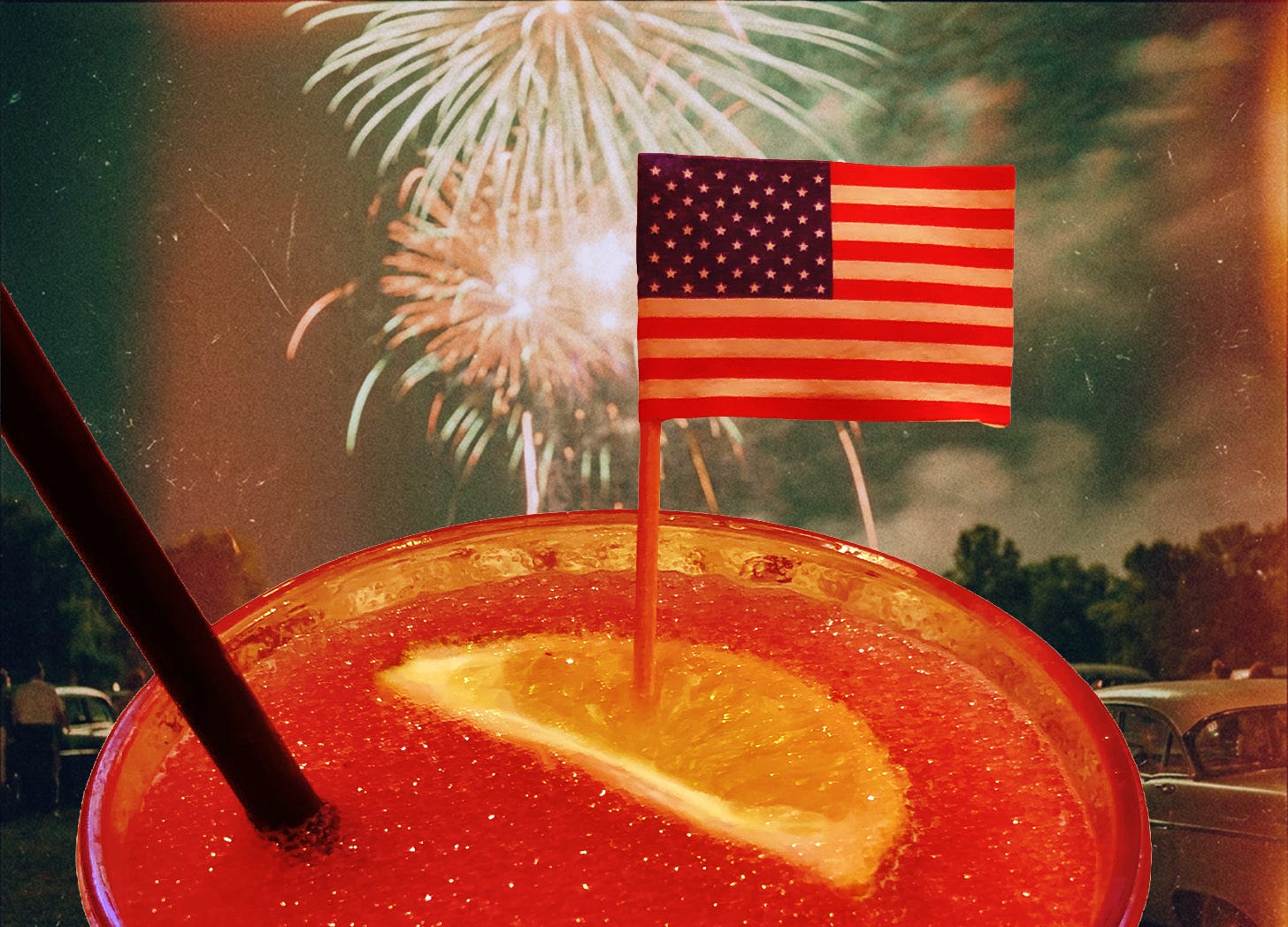
Despite all of America’s wrongs, I have a sense of patriotism toward America’s professed ideals. I’ve just never looked good in red, white, and blue — not for lack of trying. I was once a kid in the flag tee myself. One 4th of July, sitting in a lawn chair in my grandmother’s driveway, I caught my first glimpse of the difference between performative patriotism and living those ideals. I had no sophisticated analysis, just a fleeting hunch that something was off. Then I went back to enjoying the colorful explosions in the night sky.
My uncle was a small-town cop, estranged from us now — the kind who flips on his lights and siren to blow through town on a coffee run. He was also a volunteer firefighter, and he threw the best 4th of July parties on the block. Every June, his unit would catch some immigrant dairy farmer or aging hippie with illegal fireworks and confiscate the lot. Come dusk, he and his posse of public servants would break out their stashes of Ladyfingers, Roman candles, and M-80s. My uncle would hold bottle rockets in his hand and laugh at the printed instructions telling him not to as he lit the fuse.
A child subjected to copious amounts of D.A.R.E. propaganda, I was acutely aware of the law and terrified of breaking it. Their unspoken justification was that they were the law. They knew how to put out fires, and we had paramedics on site who, despite being a few beers in, assured us they could patch anyone up who lost an eye or hand. One tried to convince me that he had sewn someone's head back on. By their own reckoning, that made them the only ones fit for such spectacular displays of patriotism.
Not far from where we celebrated sat a small airfield, part private landing strip, part hub for Cal Fire’s aerial operations. When I was seven, a friend with a two-seater Cessna took me up. We buzzed my duplex and waved at my mom, skimmed the ocean, and for a few minutes, he let me take the yoke. By the time we touched down, I was in love with airplanes. It’s easy to do when you don’t have to go through TSA. The summer I was nine, I got smuggled aboard a CDF tanker to drop retardant on a redwood forest fire. My seat was a stack of catalogs duct-taped into a cushion, my grasp of danger iffy at best. After that, I was certain I’d be a pilot. With movies like Top Gun permeating pop culture, I papered my walls with military aircraft — F-15s, stealth bombers, anything that moved fast and repped the flag. Then came the Gulf War.
One afternoon, I came home from school to find my mother had taken the posters down. She was worried I couldn’t tell the difference between flying and war. Perhaps I couldn’t. As I looked up at the hairline cracks spidering out from the thumbtack holes in the plaster, I felt I had just been kicked off Team America. I’d never been more American in my life.


