


Zaatari Camp, Jordan, July 2013 — A child placed a piece of bread in my hand while barrel bombs and artillery fire echoed in the distance. His generosity was louder than war. We smiled and forgot the situation until we couldn’t. Even in the bleakest of times, people share meals.
Burbank, August 2025 — at the Talleyrand, seven of us squeeze into a banquette booth and slather our bread with butter. This fine establishment was beloved by the most golden of Californians, Huell Howser. The menu boasts a thumbs-up icon next to the hot turkey sandwich; make no mistake, it’s dripping with a glorious yellow gravy and Huell-approved. It’s Thanksgiving every day here. There’s also a full bar. The waitress, armed with a sass only found in those who got into the biz when regulars could enjoy a smoke with their omelet, informs us that the bartender pours generously. With a wink, she tells me she might sip our drinks before bringing them to the table to prevent spills.
Such uniquely American charm should not be wasted on unappreciative souls. Thankfully, my present company values brows low and high. It’s one of many things I love about them. They’re also funny as hell. The high school art teacher at the table scrolls through his phone, pulling up pictures his students drew of him while quoting their unfiltered trash talk: “Mr. Robbins, you don’t work out, do you?” We laugh. We toast the recently engaged couple, who I was confident would take the plunge. Just as we silenced our phones, we try to tune out the relentless chatter drifting through the dining room. “Trump,” this. “Trump,” that. For a brief moment, an unspoken glance circles the table as we contemplate the political leanings of the other diners. It’s good for all Americans to bump elbows where meals are shared. But is everyone safe?
It’s been two weeks since we’ve seen the street vendor who, for years, sold hot dogs and agua fresca on a corner not far from here. We heard he was thrown to the ground, brutalized, and detained by ICE agents. They hid behind masks, dehumanizing themselves so they could dehumanize others. We don’t know his citizenship status. It doesn’t matter. Did he get due process? It’s unlikely. For months, people across the country have been denied their rights regardless of citizenship status. Was he deported to a foreign prison? Is his family okay?
A blitzkrieg of headlines trudges through my skull. But soon, the world beyond our table falls under it like a napkin from a lap. I return to tales of weddings and the couple’s plans. We share what we love about our partners. The married couples recount what’s kept their relationships alive through good times and bad. This isn’t social media. We’re free to be vulnerable. We smile. We laugh. We raise our glass to love. Hugs are exchanged, a group photo is taken, and goodbyes are said.
Not long into the drive home, the headlines push on to the front of my mind. A tinge of guilt and helplessness surfaces as they contrast against a beautiful night of normalcy. It’s integral for moments of joy to leave unpleasant facts in the shadows of our shared humanity. It’s that very humanity which brings me back to face them.
I’m trying to be clear-headed about this American moment. Hyperbole is for clickbait and algorithms. Before Trump’s first term, I was a guest lecturer on Middle Eastern autocracy and the Syrian Civil War. I was also helping a family who had escaped the fascism of Syrian dictator Bashar Assad open a restaurant. One of the cooks had been brutally tortured as a teen, forced to eat human feces mixed with smashed glass. He was fortunate to be released from the notorious Sednaya prison and escape to America. However, his survival required the removal of half his stomach.
Assad, with the aid of Russia and Iran, leveled his country. Between 700,000 and 1 million people were killed. Roughly 14 million Syrians were displaced. For much of the 2010s, I interviewed survivors of war, torture, and the trauma of living in a country where, if a neighbor wants to get rid of you, all they have to do is tell the Mukhabarat (secret police) you said the leader’s name in a negative tone. That kind of fear doesn’t just change what you say or who you talk to; it changes how you think.
America isn’t there. So where are we? There are many steps along the path from a constitutional democracy to a totalitarian state. With each one, it feels like a volume knob is being turned up on an old car stereo. Everything gets louder as we progress from 1 to 11. Is the dial set at a democratic republic, illiberal democracy, a hybrid government, competitive autocracy, kleptocracy, or full-blown fascism? Are we somewhere in between? Can Americans identify the differences? Is it reaching a level where we can no longer hear each other? How do we turn it down? From the back seat, we shout, Are we there yet?!
For many Americans, regardless of political affiliations, it feels as if there’s a weighted blanket over our society. If you’re like me, it’s hard to sleep when you’re too hot. Concerns about affordability, career prospects in the age of A.I., social hostility, distrust, political violence, polarization, income inequality, misinformation, and social isolation are common topics of conversation. Everything is politicized. Uncertainty and fear are being amplified and exploited for profit and power. This isn’t new, at least not for all of us.
No matter what form of government you live under, not everyone experiences it equally. America, the “land of the free, home of the brave,” the “shining beacon on the hill.” But it’s here where Thomas Jefferson and the Committee of Five wrote, “All men are created equal,” while owning slaves and denying women voting rights. It’s here where the natives were slaughtered, the Japanese interned, and Jim Crow was the law of the land. In 1935, the Nazis looked to America’s history of racial litigation as inspiration for the Nuremberg Laws, which stripped Jews of citizenship and made interracial marriage illegal.
For some Americans, the idea that we were ever a democracy seems absurd. There has always been discrimination and efforts to enshrine unequal rights in favor of contingencies who feel threatened by the pursuit of our founding ideals. Those ideals have yet to be fully realized, but progress has been made. The greatest thread throughout American history is the collective effort and hard work that has bent that moral arc towards justice. The Trump administration is bending it back.
Since the end of World War II, sociologists and political scientists have developed statistical models to determine the conditions under which democracies backslide (transition from democracy to autocracy). By most accounts, the U.S. should be well-protected against democratic backsliding. Three factors commonly considered are the longevity of a democracy, the state's GDP (Gross Domestic Product), and income inequality.
Renowned Harvard political scientist Samuel Huntington, in his 1991 book, The Third Wave: Democratization in the late 20th Century, made a case for what he called the “Two-Turnover Test.” His thesis was that if power had been peacefully transferred from one party to another, and then back again, that democratic state was less likely to backslide. In terms of time, the Two-Turnover Test spans 10 to 20 years. Even if we grant that the U.S. wasn’t a democracy until the passage of the Voting Rights Act of 1965, his benchmark of stability has been met. The January 6th attack on the Capitol and the legislative attempt to delegitimize the 2020 election muddies the waters. More significant is that Huntington’s argument applies more to 20th-century revolutions and coups than to the gradual erosion of norms that has been prominent in the global rise of 21st-century autocracies.
According to Adam Przeworski and Fernando Limongi’s research in Democracy and Development, no democracy richer than Argentina in 1976, with a per capita GDP of $19k in today’s U.S. dollars (AFI), has backslid. As Steven Levitsky and Daniel Ziblatt note in Tyranny of the Minority, Hungary backslid with a per capita GDP of $21k (AFI). The per capita GDP of the U.S. in 2024 was $86k. While a robust economy still seems to be preventative, it’s not a rule.
As University of Chicago professor Susan C. Stokes argues in her Princeton Press book, The Backsliders, income inequality provides a leverage point for backsliding. Across several states that have experienced backsliding in the 21st century, as income inequality rose, political polarization followed. Trust in institutions eroded. As this happens, cracks in the system emerge that aspiring autocrats can exploit to dismantle it further under the guise of reform. They then break down the system from within to enrich themselves and their cronies, while finding scapegoats to blame when they fail to deliver results for citizens. The Gini Coefficient (a statistical measure of income inequality) shows that the U.S. has experienced a rapid increase in income inequality along with increased political polarization.
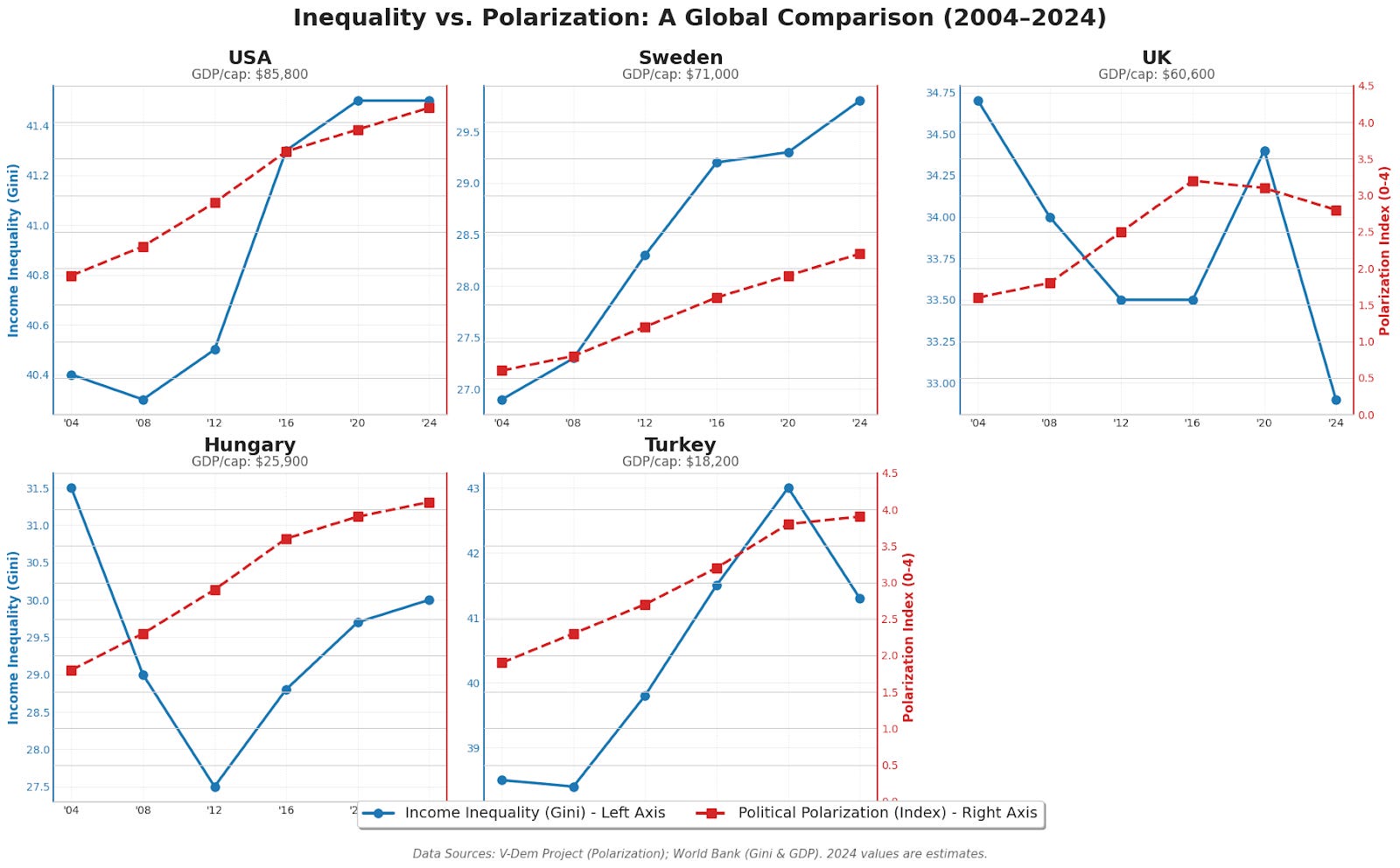
Both Brazil and Poland experienced backsliding even as income inequality declined. However, Brazil’s judiciary and Poland’s record-breaking civic mobilization halted their democratic backsliding. There’s not enough data to be conclusive, though it’s possible that lower rates of income inequality played a role.

While the longevity of U.S. democratic institutions and the strength of per capita GDP may make the U.S. appear safeguarded against backsliding, the ongoing trends of rising income inequality and political polarization suggest a greater potential for backsliding.
Bret Stephens at the New York Times, along with contributors to the Wall Street Journal editorial page and National Review, have argued that America’s “guardrails” will protect it from backsliding. The U.S. Constitution is often cited as a bulwark of democracy. Yet nearly every Latin American country that’s based its constitution on it — including Argentina, Brazil, Chile, Mexico, Peru, Uruguay, and Venezuela — has experienced repeated cycles of democratic backsliding. The Philippines, a former U.S. colony, heavily borrowed from the Constitution, even directly copying sections of it. That didn’t prevent backsliding.
Throughout history, most governments have been autocratic. There are currently between 65 and 81 autocratic countries. The number is rising. This trend doesn’t always make the news when it lacks the media appeal of violence. Most modern constitutional democracies don’t transition to autocracy through tanks and troops; they do so through lawyers and legislation. According to the study "Keeping the Democratic Facade” by Anna Luehrmann and Staffan Lindberg, since 1990, 70% of democracies that have backslid have done so through legal means. Half of those expansions of executive power were achieved through reinterpretation of existing laws.
When Trump descended on the golden escalator, left-leaning voters saw him as an easily beatable carnival barker. His autocratic ambitions were visible to people who’ve studied autocracies or lived in one. Still, it was hard to imagine a man so unfit would be elected by the American people. Yet they did. Strong baffoonish vibes aren’t unique to Trump in the halls of aspiring autocrats. Many tyrants of the past were seen as quasi-cartoon characters.
Throughout his first term, using words like 'authoritarian' to describe Trump was seen by the majority of Americans as an overreaction. If you’re caught up in the daily news, it’s easy to forget how bad things were during that first term. When he wanted to shoot peaceful protesters in Lafayette Square, it didn’t happen; there were “adults in the room” like General Mattis. Nearly a year into his second term, that’s no longer the case.
As of this writing, half of Project 2025 has been implemented. Nearly a decade into Trump’s dominance of the news cycle, pointing out his desire to be a dictator feels cliché. He’s pointed it out himself. It’s important to remember that autocracy is cliché. Autocrats would rather you see it as nostalgia. After all, rarely is what they present in the media original. Trump proudly taunted a 3rd term while wearing a hat that reads, “Trump was right about everything.”

It’s a joke, his loyalists say. Never mind how much he lies and is glaringly wrong. Never mind that instead of coming up with his own slogan, he plagiarized Mussolini, who proudly embraced the catch phrase, “Mussolini ha sempre ragione” — Mussolini is always right. Autocracy is cliché.

I could list an overwhelming number of actions this administration has taken to erode our democracy. There will surely be more by the time you’re done reading this. For the sake of brevity, if prominent examples don’t quickly come to mind, Professor Christina Pagel and her team at University College London are keeping a detailed record.
The Trump administration is historically unpopular. He’s the first president in modern history not to crack 50% approval. They’ve tried to consolidate power much faster than figures like Erdoğan in Turkey and Orbán in Hungary. This has fueled increased resistance. When scholars of 1930s fascist movements are asked why people accepted autocracy, a common quote often attributed to Mussolini is offered: “The trains run on time.” This was mostly propaganda. But enough people bought the illusion of safety and order. The Trump administration has tried to pull the same rabbit from its Mussolini hat. While they have managed to deceive some Americans regarding crime and even propagated the outright lie that Trump won the 2020 election, they are struggling to convince the majority that the economy is strong when it contradicts their daily experiences. While income inequality may be their opening, it could also be their undoing.
Unlike dictators who seize power in their prime, Trump’s health and mental acuity appear to be declining as quickly as his approval ratings. It’s unclear he’ll make it through this term, let alone be coherent enough if his administration finds a way to subvert the 22nd amendment so he can run for a third. Our elections may remain secure despite attempts to undermine them. The 2026 midterms will be revealing.
Given the damage done, there’s a chance—if we can unify across our diverse ideologies to protect our democracy— we can come back stronger than ever. But who knows? I’ve yet to find a reliable crystal ball. Dictators don’t act alone. I’ve come across opinions suggesting that when a strongman falls, their autocracy collapses with them. I can point to several cases where that isn’t true, at least not for long. There are aspects of what we’re witnessing that are unique to the 21st century. The push toward kleptocracy on this scale has no clear historical precedent but is how mafia states, such as Russia, operate. So, while there are no MAGA predecessors who combine Trump’s media savvy and charismatic base appeal, this threat could very well last beyond Trump.
Authoritarians rule by taking away the future and replacing it with fantasy. They drain citizens of hope and a sense of direction. They want the headlines rolling through the streets of your mind, perpetuating feelings of helplessness and uncertainty. They require dependence and praise. They want “truth” to be a command. If we can’t accurately discuss the good and bad of the past, we lose our references. Reality becomes malleable. If we can’t imagine a better future, how can we build one?
So what are we to do? It could be putting your body on the line if it comes to that. But for now, speak up even when daily life feels normal despite knowing it’s not for people who may not look like you or have your income. If it feels cliché, don’t let that stop you. Now’s not the time to lose momentum. This administration has three years left. It ain’t over. Give your money to companies that refuse to bend to the state. Patiently talk with family who disagree or may not be politically engaged. Run for local office. Read. Vote. I’ll be facing it with my pen (well, ok, keyboard) in hand and a stack of books by my side. You can too. And never forget, there’s strength in simply letting others know they’re not alone. Meet your friends in person. Have dinner. Be sure to pass the bread. Give them hugs, take that group photo, and never hesitate to raise your glass to love.
"Throughout history, most governments have been autocratic. There are currently between 65 and 81 autocratic countries. The number is rising. This trend doesn’t always make the news when it lacks the media appeal of violence. Most modern constitutional democracies don’t transition to autocracy through tanks and troops; they do so through lawyers and legislation."
Swinging for the fences here. Nice work, Deric.
Good work here Deric. I look forward to reading more.
One thing that concerns me is that, though there is great information out there, everything from HCR to people like you, I don't know how we reach people who don't have an upper education. Hell, even an 8th grade education. On a daily basis I feel like I'm preaching to the choir, on SM anyway. I DO talk to strangers regularly, but I'm not exactly hanging out with maga. How do we reach those people? I sometimes think HCR needs to do a Cliff notes version of her writing!